Jobs in Telegram channels: how the market works and how to avoid scams
A share of roles never reaches the job boards: they're posted in channels and filled within days. What kinds of channels exist, how to tell a real posting from noise, and what to write in the first message.
A meaningful share of roles never reaches a job board. A team lead writes a post in a community channel, gets twenty direct messages in a day, and fills the position within a week — no posting, no ATS, no queue of three hundred applicants.
It's a separate market with its own logic. Here's how it works, where the noise is, and how to apply so you get an answer.
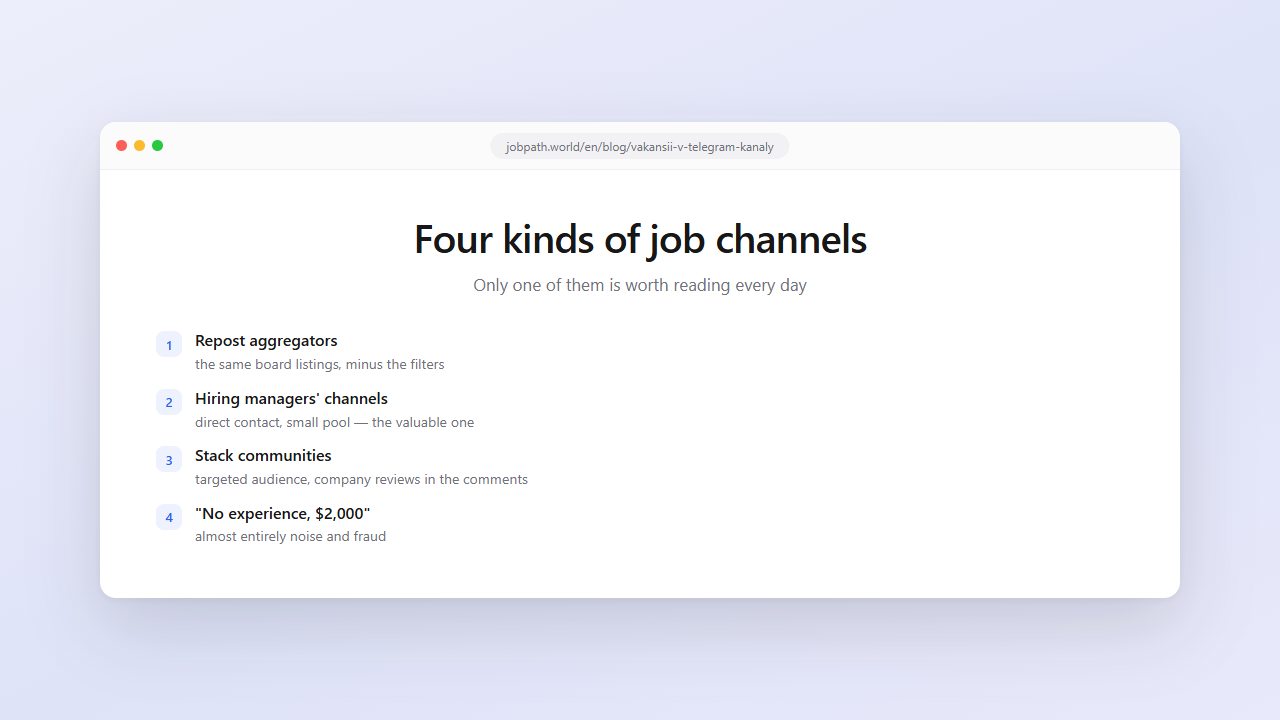
Four kinds of channels
Repost aggregators. Automatically republish postings from job boards. Nearly useless: the same roles are on the board itself, where search and filters actually work. Recognisable by volume — dozens of posts a day — and by uniform card formatting.
Hiring managers' own channels. Written by the person doing the hiring: "looking for a backend engineer for my team, here's what we build, DM me." The most valuable kind: direct contact, small applicant pool, fast replies.
Community channels around a stack. Inside a professional community where job posts are part of the life of the channel. Medium-to-high value: more competition, but a targeted audience, and the comments often tell you about the company.
"No experience needed, from $2,000." Almost entirely noise and scams. Simple rule: the louder the promise with no requirements attached, the higher the chance of fraud.
Eight signs a posting is real
- The company is named. Not "a large federal retailer" but a name you can verify.
- A salary range is stated. Or at least a band. A post with no money in 2026 is a poor sign.
- The product and stack are described. Enough to understand what you'd be doing.
- You can tell who wrote it. A person's name and role, not "the HR department".
- The contact is specific. A person's DMs or an email on the company's domain, not a form inside a bot.
- No promises without substance. "Friendly team" and "fast growth" with nothing concrete are the same red flags they are anywhere else.
- The post isn't duplicated word for word across ten channels. Mass distribution usually means an agency, not an employer.
- No money up front. Not for training, not for paperwork, not for "access to the database".
What scams look like here
Advance payment. For training, equipment, a programme, a "background check". Employers don't take money from candidates. Full stop.
"Payment processing manager". The classic money-mule pattern: accept transfers to your card and forward them on for a percentage. That's participation in laundering, and you're the one who answers for it.
A take-home with a surprise. The most dangerous pattern for developers: a repository arrives as a "test task" with a stealer hidden in a dependency or a config. Running it on your main machine costs you passwords and wallets. The rule is simple — run someone else's code only in an isolated environment.
Phishing as a recruiter. A link to a "company portal" asking you to sign in through a familiar service. Check the domain letter by letter.
Documents requested before the interview. Identity documents belong to onboarding, not to first contact.
What to write in the first message
Telegram works differently from a job board: you're writing to a person, and you have about three lines before they collapse the chat.
Hi! Saw the backend engineer post in [channel].
Four years on Python, the last two on a payments service in FastAPI, 4,000 rps at peak. I match your stack except Kafka — my queue experience is RabbitMQ.
Resume: [link]. Would a call this week work?
Three things do the work here: the first line says where you came from (people run several channels and don't remember where they posted what), the second gives facts and names the gap honestly, the third proposes a next step.
What not to do: send "Hi, is this position still open?" and wait. It carries no information, often gets no answer, and the follow-up then reads as pushy.
Duplicates: one job across ten channels
A common situation: the same role appears in five channels with different wording. Apply to each and you may message the same person three times.
How to tell: compare the product description and requirements, not the headline. A matching stack, the same range and a similar text structure almost always mean one job. Keeping a list of where you wrote and when pays for itself.
How this looks in JobPath
We collect posts from open channels and turn them into cards: noise, duplicates and board reposts are filtered out, and the rest is parsed into role, salary, requirements and contact. What you get is an ordinary feed with filters instead of endless scrolling.
The point isn't to replace reading channels, it's to avoid reading a hundred posts for the two that fit. How it works.
FAQ
Is it worth looking for work in Telegram channels?
Yes, as an additional channel. Some roles appear there before the boards or never reach them, and a post in a hiring manager's own channel draws far fewer applicants. As your only source, no — coverage is unpredictable and depends entirely on what you're subscribed to.
How do I tell a real posting from a scam?
By the combination: a named company, a stated salary range, a described product and stack, an identifiable author, a specific contact. And the one absolute rule — no money up front under any pretext.
Is it dangerous to do a take-home task from Telegram?
Not inherently, but run someone else's code only in an isolated environment — a container or a VM. The tampered-dependency pattern inside a "test repository" is real and specifically targets developers.
What should I write in a direct message?
Three lines: where you saw the posting, two or three facts from your experience that match its requirements, and a proposed next step. "Is this still open?" carries no information and often gets no reply.
Why does the same job appear in different channels?
Employers and agencies post in several places at once, and aggregators republish them. Compare the product description and requirements rather than the headline, or you'll message the same person repeatedly.
They're asking for my documents before the interview — is that normal?
No. Identity documents belong to onboarding. A request for them at first contact is a data-harvesting pattern, not hiring.