Interview trap questions: eight classics and how to answer them
"What's your greatest weakness" doesn't test weaknesses. It tests whether you have a working model of yourself. Eight questions everyone gets asked, and the shape of an answer for each.
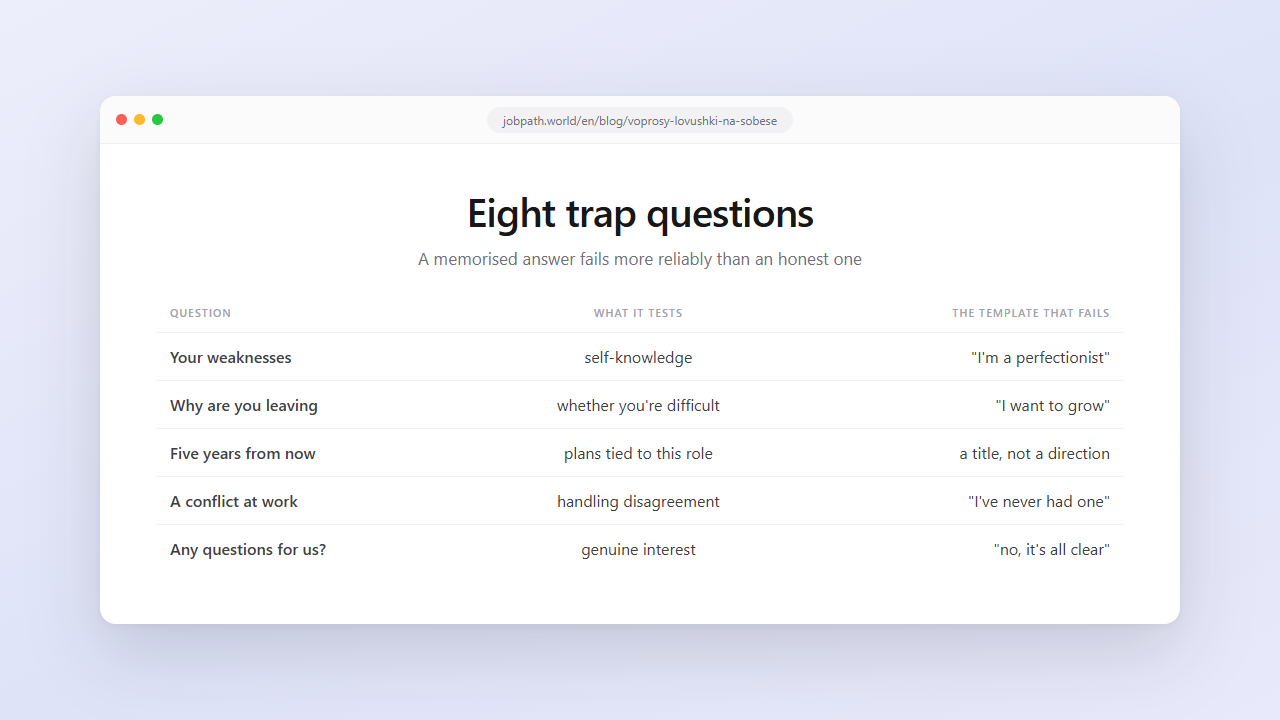
The trap in these questions isn't where people look for it. The interviewer isn't trying to catch you out — they're testing something that can't be asked directly: how well you understand yourself, and whether you can discuss something uncomfortable without flinching.
Which is why a memorised answer fails more reliably than an honest one. "I'm a perfectionist" is a disguised boast, and it reads as either poor self-knowledge or unwillingness to be straight.
Eight questions: what each tests, why the template fails, and what to build instead.
1. What are your weaknesses?
What it tests. Whether you have a working model of yourself and a mechanism to compensate. The weakness itself barely matters.
Why the template fails. "Perfectionism", "workaholism", "too demanding of myself" are virtues in costume. Interviewers have heard them hundreds of times.
The shape. A real weakness that isn't fatal for this role, plus how you handle it in practice.
"I context-switch badly — if I'm interrupted every twenty minutes the quality drops. So I agree on two question windows a day with the team and route genuinely urgent things separately. It works."
One sanity check: the weakness must not disqualify the role. A developer can say they dislike public speaking; a team lead can't.
2. Why are you leaving your current job?
What it tests. Whether you're difficult, and whether the reason will repeat here.
Why the template fails. "I want to grow" means nothing and sounds like evasion.
The shape. Moving towards, not away from: one real reason stated neutrally, then immediately what you're looking for.
"The project moved into maintenance and new work stopped appearing. I want to build from scratch again — your posting is about launching a new service."
Never criticise a former manager, even when it's deserved: the interviewer doesn't hear a story about them, they hear how you'll talk about this company a year from now.
If you're leaving over money, say so. It's a legible reason, and hiding it creates an inconsistency.
3. Where do you see yourself in five years?
What it tests. Whether your plans involve this role, and whether you'll leave in six months.
Why the template fails. "I want to become a manager" in a role with no management path is a direct signal that you'll leave.
The shape. A direction rather than a title, tied to what this job provides.
"I want to go deep on distributed systems and become the person people bring architecture questions to. That happens here on real load rather than in theory."
An honest "I don't plan five years out, but for the next two I want this" beats an invented career ladder.
4. Why should we hire you?
What it tests. Whether you can state your value without either self-deprecation or bluster.
Why the template fails. "I'm responsible and I learn fast" describes everyone.
The shape. The intersection of their problem and your experience, in one sentence, with a fact in it.
"Three bullets in your posting are about payments and idempotency. I ran a payments service for two years and we fixed double charges in it — you'll need that in the first week."
If the overlap isn't there, say so. "I match half the requirements exactly; I don't have Kafka, but I have RabbitMQ" is stronger than a stretched claim.
5. Tell me about a conflict with a colleague
What it tests. Whether you can handle disagreement without making it personal.
Why the template fails. "I haven't had conflicts" is either untrue or describes someone who avoids hard conversations.
The shape. STAR: the situation, what the disagreement was actually about, what you did, how it ended. No character assessments.
"The architect and I disagreed on storage — I wanted relational, he wanted document. I built a prototype over a weekend with numbers from our query patterns and brought it to the meeting. We went relational, but with his index design, which was better than mine."
A good answer concedes at least part of the other person's case. That's rare, and it's memorable.
6. Why so many job changes, or why the gap?
What it tests. Whether something is hidden, and whether you'll leave just as fast.
Why the template fails. A long justification holds attention on the topic far longer than it deserves.
The shape. Calm, one or two lines, no apology, then back to facts.
"Two moves in three years: the first project was cancelled along with the whole direction, and I stayed at the second exactly through the release we'd agreed on. I'm looking for somewhere long-term now because the work here is long."
Same for a gap: one line on the reason, one on what you kept sharp.
7. What didn't you like about your last manager?
What it tests. Loyalty and boundaries: how you talk about people who aren't in the room.
Why the template fails. Both "everything was fine" (untrue) and a detailed list of grievances (a red flag) lose.
The shape. Name a difference in approach rather than a defect in a person, and say what suits you.
"We saw task detail differently: he'd give a direction, and I work better when the definition of done is agreed up front. It isn't good or bad — the second style just fits me better."
8. Do you have any questions for us?
What it tests. Interest, and whether you've thought about the job seriously.
Why "no" is a bad answer. It's the one question where silence counts as an answer, and the answer is "not that interested".
What to ask. Three that work:
- "What does success in this role look like at three months?" — reveals whether they have clear expectations.
- "Is this a new role or a replacement?" — if it's a replacement, ask what happened.
- "What's the hardest thing in the team right now?" — the most honest question there is; whether they answer it straight tells you a great deal.
The shared mechanics
All eight are built the same way.
Facts instead of judgements. "The project moved into maintenance" rather than "it got boring".
Short. Two or three sentences. The longer the answer to an uncomfortable question, the more attention it draws.
No apologising. Tone does half the work: the same content lands differently depending on whether you're explaining or justifying.
Forward-facing. End on what you're looking for and what you bring, not on what was wrong.
The eight above are the classics, not the full list: every company keeps its own standbys. The question bank filters by company and grade, and keeps the behavioural section separate from the technical one.
These questions are one hundred per cent predictable, which is why they're worth saying out loud once and hearing yourself. Mock interviews with a debrief give you exactly that: same questions, same format, no cost to being wrong.
FAQ
How do I answer the weakness question?
Name a real weakness that isn't fatal for the role and explain how you handle it in practice. "Perfectionism" and "workaholism" read as virtues in disguise and work against you.
What do I say about why I left my last job?
One neutral reason in "moving towards, not away from" form: what ended at the last place and what you're looking for next. Criticising a former manager ends the conversation faster than any technical mistake.
How do I answer "where do you see yourself in five years"?
Give a direction rather than a title and connect it to what this job provides. An honest "I don't plan five years out, but here's the next two" beats an invented ladder.
Can I say I've never had a conflict at work?
Better not — it reads as untrue or as conflict avoidance. Use a real case in STAR shape where the disagreement is described on its merits rather than through a judgement of the colleague.
What should I ask at the end of an interview?
What success looks like at three months, whether the role is new or a replacement, and what's hardest in the team right now. "No questions" reads as a lack of interest.
Why don't memorised answers work?
Because interviewers have heard them hundreds of times and can always ask a follow-up. A memorised phrase survives until the second "why that way?"; a real example from your experience survives any number of them.