Your interview is recorded: what happens to the file, and your rights
Recording an interview is normal and usually lawful. What candidates rarely know is the rest: how long the file lives, how to have it deleted, and — in the EU — the right to a human review of an automated rejection.
Almost everyone records interviews now: a recruiter would rather show the hiring manager the conversation than paraphrase it. That's normal and generally lawful. The problems start where the candidate has no idea what happens to the file afterwards.
Here's how to tell a recording is running, how long it lives, and what you can ask for — under EU, US and Russian rules.
How to tell you're being recorded
Meeting services make it explicit: Zoom shows an icon and a pop-up notice, Google Meet displays a recording label, Microsoft Teams puts a banner in front of every participant. You can't start a recording silently through the built-in feature.
Two cases have no indicator: someone capturing their screen with separate software, and an online assessment, where recording is part of the procedure and is stated in the rules you accept before starting.
The simple move is to ask at the start. "Are we recording?" is an ordinary question that sets the frame for everyone.
EU: GDPR and the new AI rules
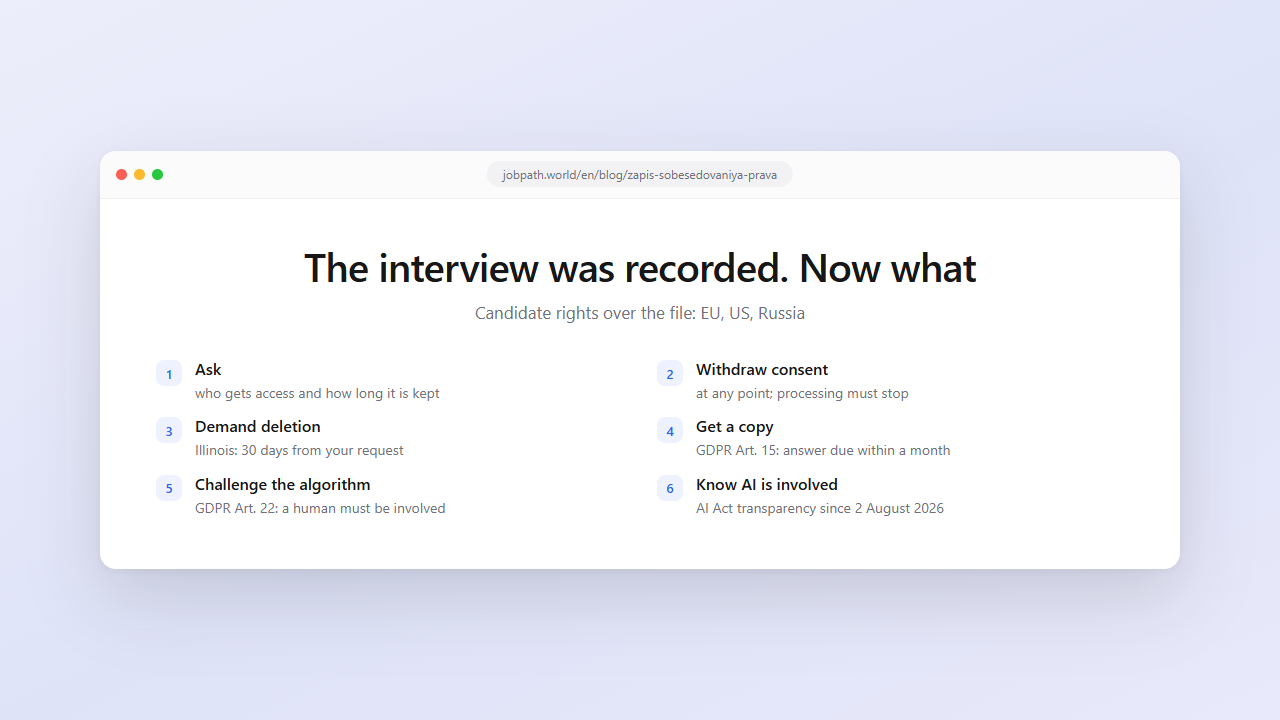
Right of access (Article 15). You can request a copy of your personal data — including the interview recording and the assessments built from it. The response is due within a month.
Right to erasure (Article 17). Deletion once the purpose is met or consent is withdrawn.
Automated decisions (Article 22). If a rejection came solely from an automated system, you have the right not to be subject to that decision, to get an explanation, and to demand human involvement. This applies directly to video interviews with automatic scoring.
The AI Act. The picture shifted through 2026, and as of September it looks like this: the transparency obligations in Article 50 have applied since 2 August 2026, while the full high-risk regime for Annex III systems — which covers AI used for recruitment and candidate selection — was deferred by the Digital Omnibus package to 2 December 2027.
In practice: it's too early to demand the complete high-risk safeguards, but transparency is already owed. You're entitled to know that an AI system is involved, which one, and for what.
US: three laws worth knowing
Illinois, Artificial Intelligence Video Interview Act. In force since 2020. An employer using AI to analyse video interviews must notify the applicant, explain how the system works and which characteristics it evaluates, obtain consent, limit who receives the video, and destroy the recording within 30 days of the applicant's request — including copies held by contractors.
New York City, Local Law 144. Since 2023, automated employment decision tools require an annual bias audit with published results, and candidates must be notified at least 10 business days in advance.
Maryland. Consent is required before facial recognition is used during an interview.
Russia: what 152-FZ gives you
For employers processing data in Russia, the personal data law applies. Processing requires consent, and if the recording is used to establish identity it counts as biometric data requiring written consent. The important right is withdrawal: consent can be revoked at any time, after which the operator must stop processing and destroy the data unless another lawful basis exists. Retention is whatever the consent form states — commonly six months to a year after the application.
Can you record it yourself?
As a participant recording for personal use, generally yes — the restrictions bite on distribution rather than recording. Publishing a recording of another person without their consent is a different matter.
The practical and safe move is to say out loud at the start that you're recording for yourself. You'll rarely hear an objection, and the conversation gets cleaner for both sides. The file is worth having: reviewing your own interview is the cheapest preparation for the next one.
Assessment and proctoring platforms are a separate case, where screen recording on their side can be a mandatory part of the procedure.
Four questions worth asking a recruiter
- Is the meeting recorded, and who gets access to the recording?
- How long is it kept, and what happens then?
- Is any automated scoring applied to my answers?
- Where do I write to have my data deleted after the process ends?
None of these reads as confrontational, and the answers often say more about a company than the job ad does. An employer that stumbles on the second question probably hasn't built the process at all.
FAQ
Is an employer allowed to record an interview?
Yes, with the candidate's consent and a stated purpose. A recording is personal data, so it needs a lawful basis, a defined purpose and a retention period. In meeting services, recording always raises an indicator visible to every participant.
How do I get an interview recording deleted?
Withdraw consent and request erasure in writing at the address given in the company's privacy policy. Under GDPR that's an Article 17 request; in Illinois, an AI-analysed video interview must be destroyed within 30 days of your request, including copies held by third parties.
How long is an interview recording kept?
As long as the privacy notice or consent form says — typically six months to a year after the application. Both GDPR and Russian law require deletion once the purpose of processing has been met.
Can I record the interview myself?
As a participant recording for personal use, generally yes. Restrictions apply to distributing it — publishing a recording of another person without their consent is not the same as keeping one for review. Announcing it at the start is the sensible approach.
What if an algorithm made the decision?
In the EU, Article 22 of GDPR gives you the right not to be subject to a decision based solely on automated processing, to receive an explanation, and to demand human involvement. Illinois and New York City add their own notice and audit requirements.
What changed in EU AI rules for hiring?
The Article 50 transparency obligations of the AI Act have applied since 2 August 2026. The full high-risk regime for Annex III systems, which includes AI used to select candidates, was deferred by the Digital Omnibus package to 2 December 2027.