Salary expectations: what to say and how to negotiate
The expectations question comes up three times in a process and means something different each time. What to say at each point, how not to name a number first, and what's negotiable when base pay is capped.
The money conversation is the shortest and most expensive part of hiring. Five minutes here are worth more than a month of technical preparation: a difference of a few hundred a month compounds across a year, and you only join once.
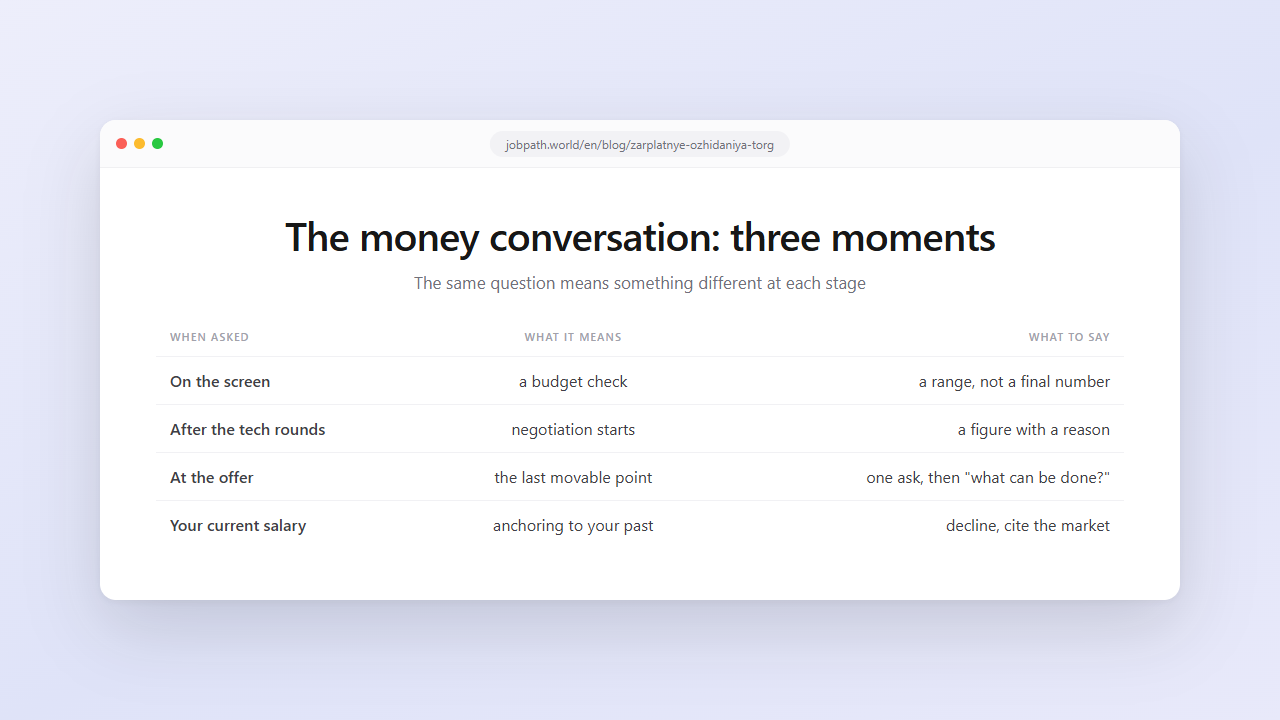
The question comes up three times in a process, and it means something different each time.
Three moments
On the recruiter screen. Not a negotiation, a budget check: they're seeing whether you fit the band so nobody wastes two weeks. A range belongs here, not a final number.
After the technical rounds. Now it's a real conversation: the company has invested in you, you know the scope, and the positions have changed.
At the offer. The last point where the number moves. After signing, it doesn't move until the next review.
Who names a number first
The rule is simple: the first number spoken frames the conversation. So the optimal move is to ask for theirs.
"What's the budget for this role? It's easier for me to work from your range so we don't waste each other's time."
It's a normal question, asked constantly, and about half the time they'll tell you. Increasingly the range is in the posting anyway.
If they won't say and press for your number, don't keep dodging — the recruiter has a box to tick, and evasion reads as insecurity.
"I'm looking at 95–115k. The final number depends on scope, work format, and how reviews are handled."
Three things work here: a range instead of a point, an explicit statement of what the figure includes, and the note that it depends on conditions, which keeps room for negotiation.
The bottom of your range is a number you'd genuinely accept, plus a margin. Say 95 and you'll be offered 95. Never name a figure you'd decline.
The current-salary question
Asking your current salary anchors the offer to your past rather than to the market. You don't have to answer, and there's a calm way to decline:
"I'd rather not anchor on my current salary — it reflects an agreement from three years ago. For this role I'm looking at 95–115k, which matches the market for this scope."
Tone matters more than wording here: no challenge, no apology. People rarely push twice. In several US states and jurisdictions asking at all is prohibited, which is worth knowing.
The script when the offer is below your range
The most common situation and the most commonly missed opportunity: most candidates accept the first offer silently.
Step 1. Thank them and take a pause. "Thanks for the offer, I'm interested. Could I take a day and come back with questions?" is normal and expected.
Step 2. Come back with one number and a reason.
"Everything works except the number. From my data the range for this role is 105–125k; I have four years on this stack and the payments experience your posting asks for. 115 would work for me. What can be done?"
What does the work: one specific figure instead of "a bit more", a reference to data rather than feelings, and an open question at the end that hands the move to them.
Step 3. Be ready for no. If the budget really is fixed, ask about the alternatives — there usually are some.
Ask once. A second push after a concession damages the relationship before you've started.
What's negotiable besides base pay
When base is capped, these usually move more easily because they sit in different budgets.
- A review in six months with criteria written into the offer. The most valuable item when money isn't available now.
- A signing bonus. A one-off doesn't disturb the salary bands, so it's easier to approve.
- The title in the offer. It affects your next offer and your internal reviews.
- Work format. Two remote days a week is real money in commuting and time.
- Vacation and equipment. Extra days and a decent laptop cost the company less than a raise.
The phrasing: "If base is at the ceiling, could we write a six-month review with criteria into the offer?"
Five mistakes that cost money
Naming your current salary. Anchors the offer to your last job rather than the market.
Naming one number instead of a range. A point leaves nowhere to go.
Apologising for your number. "I know that's a lot…" — you just discounted yourself.
Negotiating before an offer exists. There's nothing to negotiate until the company has decided it wants you.
Inventing competing offers. One question about your decision timeline exposes it, and the reputational cost dwarfs the gain.
About the counter-offer from your current employer
The classic trap. When you resign, your employer often offers a raise, and it feels like a win.
Worth remembering: the reason you were leaving is rarely only money, and money that appeared in a day could have appeared earlier. You're also now marked as someone who looked elsewhere, which affects how you're planned for.
A counter-offer is worth accepting when it solves the original reason for leaving, not just the number.
Where the data comes from
Feelings are a weak argument; numbers are a strong one. Three sources work: published ranges in postings for the same role, salary surveys for your stack, and an estimate for the specific job from its description — our tool builds a range from the requirements and gives you talking points.
Collect three or four references in advance. In the moment, "from my data the range is 105–125" lands very differently from "I was hoping for a bit more".
Rehearse the conversation itself as well. "What are your salary expectations" is a behavioural-section question, and it sits in the question bank along with the wordings different companies use for it.
FAQ
What should I answer when asked about salary expectations?
Ask for their range first: "What's the budget for this role?" If they won't say, give a range, state what it includes, and note that the final number depends on scope and conditions. The bottom of that range must be a number you'd accept.
Do I have to share my current salary?
No. The question anchors your future offer to a past agreement. A calm decline plus your own market-based range works, and in several jurisdictions the question isn't allowed at all.
Can I negotiate after receiving an offer?
Yes, and it's an expected part of the process: thank them, take a day, come back with one specific figure and a reason, and close with "what can be done?". Ask once.
What if the budget really is fixed?
Negotiate what sits in other budgets: a signing bonus, a six-month review with written criteria, the title in the offer, remote days, extra vacation, equipment.
Should I accept a counter-offer from my current employer?
Only if it addresses the real reason you were leaving rather than the number alone. Money that materialises in a day after a resignation could usually have materialised earlier.
How do I work out my market range?
From three sources: published ranges in comparable postings, salary surveys for your stack, and an estimate for the specific role from its description. Three or four references gathered in advance turn the money conversation from an argument into an exchange of data.