Cover letters: 7 templates and the phrases that kill them
A recruiter sees the first line and a half of your letter in the application list preview. Everything after that gets read only if those lines earned it. Seven templates and the phrases that waste them.
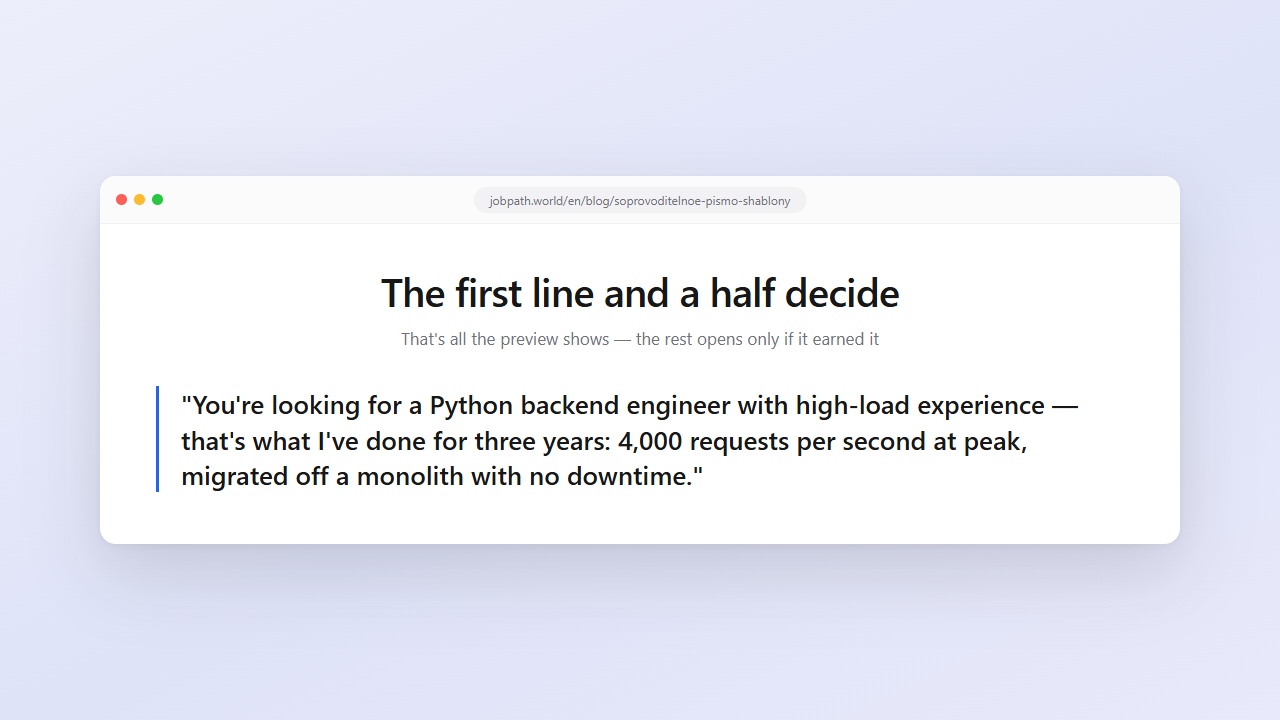
The thing to understand about cover letters: in the application list a recruiter sees a preview — the first line and a half. The rest opens only if the opening earned it.
Which gives the rule every template below is built on: the first sentence is about the role and one concrete fact from your experience, not about you in general. "Hello! I was interested in your vacancy" is a wasted preview.
Length: five to eight lines. A letter doesn't retell the resume; it explains one thing — why you, and why here.
1. Standard application, experience matches
The base case: you fit the requirements, and the job is not to bury that in prose.
You're looking for a Python backend engineer with high-load experience — that's what I've been doing for three years at [company]: a FastAPI service handling 4,000 requests per second at peak, migrated off a monolith with no downtime.
The requirement about asynchronous payment processing caught my eye: we solved something similar with a queue and idempotent handlers, happy to walk through the details on a call.
Resume attached. Available any time this week.
It works because the first line quotes their requirement and answers it with your number. The second proves you actually read the posting.
2. Career change
Here the letter matters more than the resume: on paper you don't fit, so the job is to reframe.
I spent eight years in procurement and the last two automating it in Python — price-monitoring scrapers and Pandas reporting the whole department ended up using.
I'm moving into engineering deliberately, and from the side where I know the domain: your logistics product covers exactly the processes I used to run by hand.
Stack: Python, SQL, Docker, with projects on GitHub. Happy to do a take-home.
The move: the previous career is presented as an advantage for this specific role rather than as ballast.
3. Little experience
The junior mistake is apologising. The opposite works: show one real thing you've built.
Junior analyst, six months of commercial experience: during an internship at [company] I built cohort reports and a Metabase dashboard the team still uses.
Your posting pairs SQL with visualisation — that was my daily work, including rewriting queries that were timing out.
Ready for a take-home, and available part-time during a probation period if that helps.
No "motivated self-starter who learns quickly" without evidence. One concrete artefact that outlived you beats five adjectives.
4. An employment gap
They'll ask anyway, so it's cheaper to explain it yourself in one line, without apologising.
I took a year out for family reasons and kept my hands in — a Go side project and a Kubernetes certification.
Before that, five years in infrastructure: moved 40 services to Kubernetes and cut release time from an hour to eight minutes.
Fully available now and can start within two weeks.
The formula: one calm line about the reason, then straight back to facts.
5. Overqualified
Overqualified candidates get rejected out of fear: "they'll leave in six months" or "we can't afford them". Both objections belong in the letter.
I can see you're hiring at mid level and I have nine years, including a lead role. Here's why I'm applying anyway: I'm deliberately moving out of management back into engineering, and I'm not treating this as a stopgap.
On compensation, I'm aiming at your published range — I understand the level of the role and I'm choosing it.
What comes free: code review and mentoring habits that teams usually find useful.
Directness beats silence here. The recruiter will have the thought regardless; the only question is whether your answer is next to it.
6. Referral
The strongest letter there is: a name inside the company lifts your application out of the stream.
[Name] from your platform team suggested I get in touch — we worked together at [company] on the billing migration.
They mentioned you're hiring for integrations: that's been my focus for four years, most recently an acquiring integration handling 200,000 transactions a day.
Resume attached, and [name] knows I'm applying.
The name goes in the first line or it may as well not be there — the second paragraph might never be reached.
7. Cold email, no open role
Writing directly to a company you like needs a different structure: usefulness first, request second.
I've used your app for about eighteen months and noticed the order screen hangs on an empty state when the network is poor — it reproduces reliably on Android, happy to send the details.
I'm a mobile engineer, six years on Kotlin, three of them in teams with offline-first architectures.
I don't see an open role, but if you're planning to hire for the mobile team in the coming months, I'd be glad to talk.
It works because the first line is useful to the reader whether or not they ever hire you.
Five phrases that kill a letter
"Hello! I was interested in your vacancy." A wasted preview with no facts in it.
"I'm a motivated, stress-resistant fast learner." Everyone writes this, and it means nothing without an example.
The resume retold in prose. They already have the resume. The letter is for what isn't in it.
"Open to any opportunities." Reads as "I don't care where" and lowers your odds for this specific role.
Two screens of text. Doesn't get read at all. Five to eight lines.
About templates and automation
The same text sent to a hundred postings performs worse than no letter at all: it proves you didn't read the description.
So the templates above are structures, not text to copy — the facts and the quoted requirement have to be yours. If you're applying at volume, that part can be automated: the letter is assembled per posting from its description and your resume. The rule doesn't change, though — the facts must be real, or the first call exposes them.
FAQ
Do I even need a cover letter?
Yes when the role is competitive or your case is non-standard — a career change, a gap, limited experience. In those situations the letter reframes what the resume implies. For a perfectly matching profile it matters less, but it never hurts.
How long should a cover letter be?
Five to eight lines, one screen without scrolling. The first line and a half matter most: that's what appears in the application list preview and decides whether the letter is opened.
What goes in the first line?
A specific requirement from the posting plus the fact from your experience that answers it. "You're looking for X — I've done exactly that for three years, here's the number." Greetings and "I was interested in your vacancy" waste the preview.
How do I explain an employment gap?
In one calm line without apologising, then straight to facts: what you did, what you kept sharp, when you can start. A long explanation draws more attention to the gap than it deserves.
Can I reuse one template for every application?
Identical text across a hundred postings performs worse than an empty letter, because it shows the description went unread. What works is a reusable structure with facts swapped in per role — by hand or automatically.
What if I have less experience than the posting asks for?
Don't apologise; show one concrete result — a project, a dashboard, a service someone uses. Requirements are usually inflated, and a one-to-two-year gap closes with evidence that you've done something similar.