How many job applications a day: limits and pacing
The ceiling is around 200 applications a day from one resume, but hitting it isn't winning. What over-sending actually triggers, why the counter can lie, and how many applications you really need.
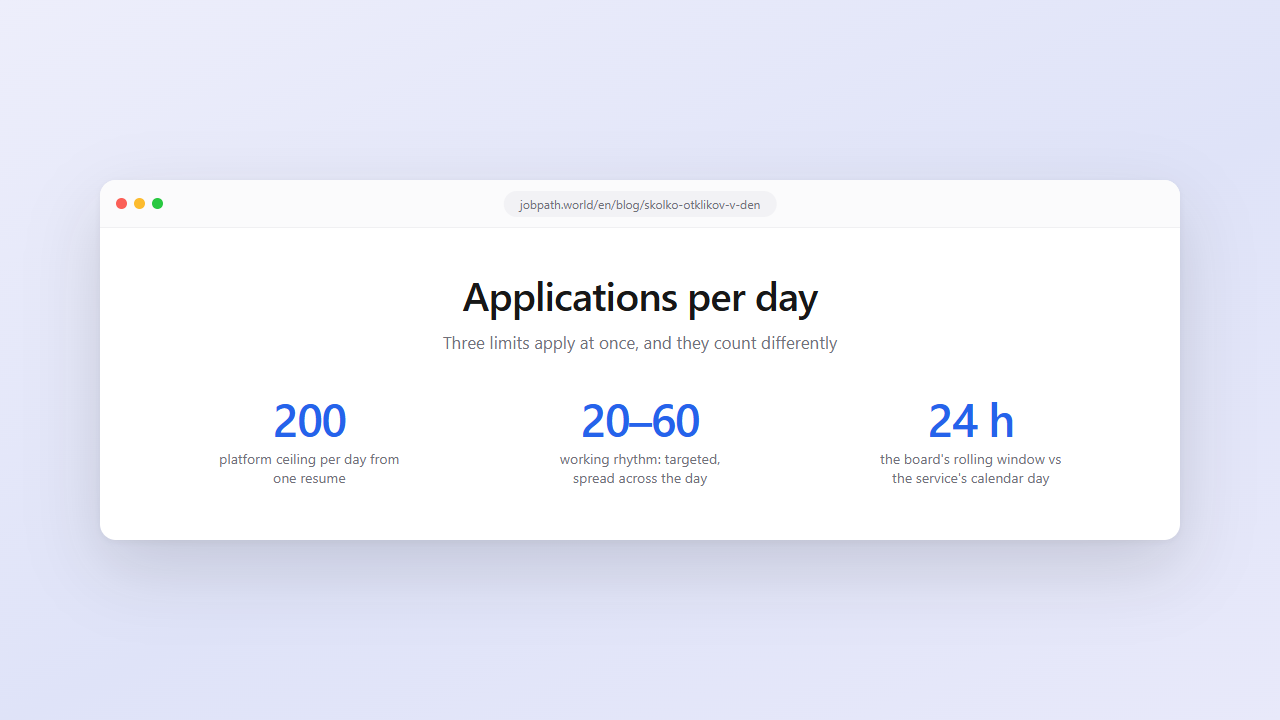
Short answer: the technical ceiling is roughly 200 applications per day from a single resume, and that's an upper bound rather than a target. A sensible rhythm for most people is 20 to 60 targeted applications a day, sent during working hours to roles that actually match.
Here's what that answer is built from.
Three limits apply at once
The platform's limit. Job boards cap how many applications one resume can send per day. Once you hit it, further applications simply stop going through: the server responds with a limit-exceeded error.
The service limit. If applications are sent automatically, the service has its own daily cap. Ours depends on the plan: 15 a day on free, 50 on Basic, 200 on Premium — where the cap matches the board's own ceiling.
The campaign limit. A separate "how many per day" setting inside one search. Worth keeping below your plan cap when you run several searches: otherwise one broad query eats the entire daily budget before the others start.
Why the counter can say you have quota when applications fail
The most common confusing situation: the service says 40 of 200 sent today, and the board refuses anyway.
The two count differently. The service counts calendar days — the counter resets at midnight. The board usually looks at a rolling window: how many applications went out in the last 24 hours, regardless of whether midnight happened in between.
Which means a hundred applications fired off at 11pm yesterday are still inside the window at 9am today, even though the calendar day is new.
Hence the rule: don't dump your daily allowance in one burst. Applications spread across a working day with pauses go through more reliably than a hundred in ten minutes.
What over-sending actually triggers
In order of severity:
A pause. The board answers 429 "too many requests", and any sane service backs off for a few minutes instead of hammering on.
A stop for the day. The daily limit is spent; nothing more goes out until tomorrow.
A captcha. The account gets a "are you human?" challenge. Until someone solves it by hand, automation can do nothing and the campaign halts.
An account block. The extreme case, and it's driven by behaviour rather than volume: applications every two seconds around the clock, hundreds of them to roles unrelated to your profile.
Ordinary hygiene — pauses, working hours, relevant roles — removes the first three almost entirely.
Why 300 blind applications beat 50 targeted ones only in the wrong metric
There's a temptation to treat application count as the goal. The problem is that what grows isn't invitations, it's rejections.
Recruiters spot irrelevance faster than you'd think. A mid-level engineer applying for a team lead role in an unfamiliar stack is closed in two seconds. Twenty of those produce twenty rejections and nothing else.
Duplicates eat your allowance. The same role is often posted in five cities. Without de-duplication, five applications go to one job and come back as one rejection. Our service collapses those clones and remembers what has already gone out, so the same role doesn't come round twice.
The employer's side is already flooded. A popular posting collects 200-400 applications in its first day, and only a handful get read to the end. The goal isn't to add to that pile — it's to be in the handful.
How many you actually need
Arithmetic instead of intuition.
Take your own conversion: invitations per hundred applications. The arithmetic is then simple. Say it's 5% and you want five interviews a week — that's about 100 relevant applications a week, 20 per working day. Substitute your own number.
If your conversion is very low — a couple of invitations across hundreds of applications — volume isn't the problem. The resume or the targeting is, and sending more will only multiply rejections. Check the resume and narrow the filters first, then scale.
A practical rhythm
- 20–60 applications a day per search, spread across the working day.
- The employer's working hours rather than the middle of the night — a hundred applications at 3am has a recognisable shape.
- A pause between applications, not one per second.
- A campaign cap below your plan cap when you run several searches.
- Check conversion weekly, not volume.
All of it is configured once in a campaign and then runs inside your own job-board account, on your instruction, through your own login.
FAQ
How many job applications can I send per day?
The platform ceiling is around 200 per day from one resume. Service caps on our side are 15 a day on free, 50 on Basic and 200 on Premium. A sensible working rhythm for most people is 20–60 relevant applications a day.
Will I get banned for mass applying?
Not for volume itself. What causes problems is behaviour: no pauses, round-the-clock sending, and mass applications to irrelevant roles. The usual escalation is a temporary pause, a stop for the day, a captcha, and only in extreme cases an account block.
Why do applications fail when I still have quota?
Most likely the platform's rolling window: it counts the last 24 hours while the service counts calendar days. A large burst late yesterday evening is still inside the window this morning.
What do I do when a captcha appears?
Solve it manually in a browser while signed into your account. Until it's cleared, automated sending is impossible — it's not a service failure but a platform protection that only a human can clear.
How many applications does it take to get an interview?
There's no universal number: it depends on the field, the level, and how precisely the jobs were targeted. It's more useful to measure your own conversion — invitations per hundred applications — and plan volume from that.
Does sending more help when nobody replies?
Not if conversion is very low. That's a signal the resume or the targeting is off, and volume will only multiply rejections. Fix those first.