Working abroad in 2026: three routes and real timelines
The first filter isn't your English or your experience — it's the right to work in the country. Three realistic routes, the 2026 Blue Card thresholds, how to rebuild a CV for international hiring, and how long this actually takes.
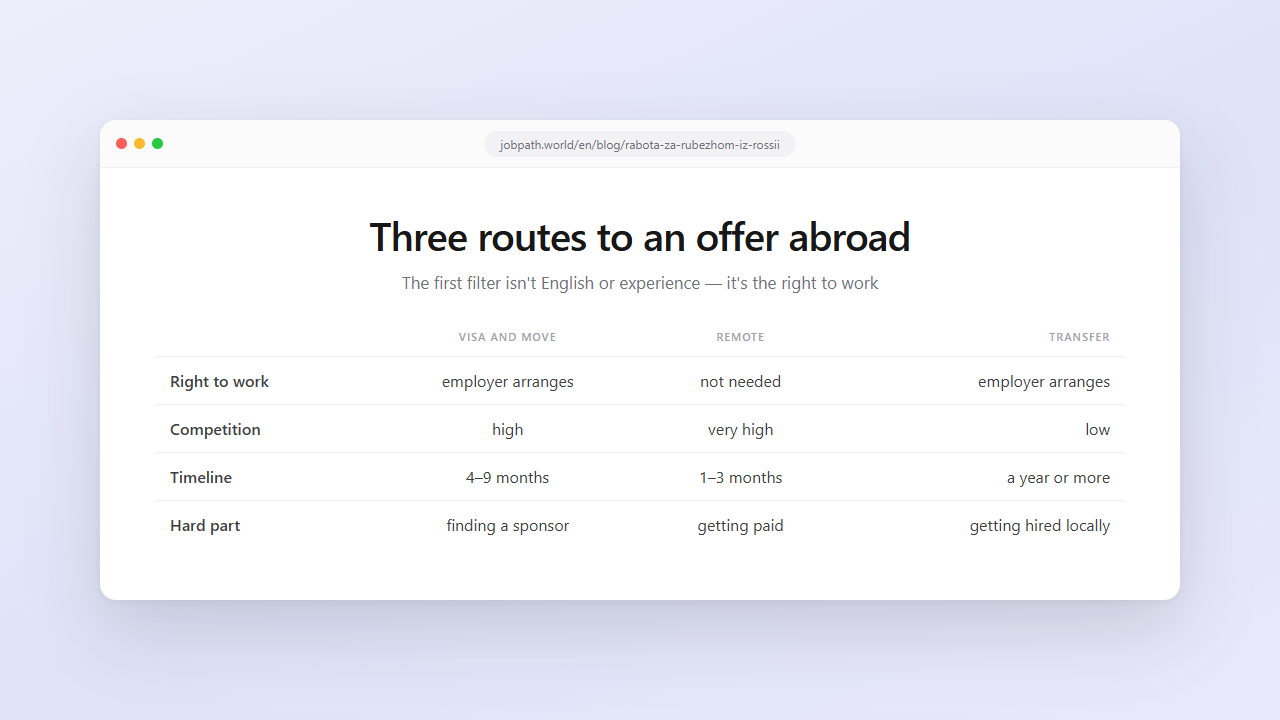
The thing to understand before your first application: in international hiring the first filter isn't experience or English, it's the right to work in the country. "Do you have the right to work in the EU?" appears in the application form before anything else, and "no, but I'm open to relocation" filters most roles out automatically.
Strategy follows from that. There are three routes, and they need different preparation.
Three routes
| Visa and relocation | Remote for a foreign company | Internal transfer | |
|---|---|---|---|
| Who pays for the move | often the employer | nobody, you stay put | the employer |
| Right to work | arranged by the employer | not needed, you're a contractor | arranged by the employer |
| Competition | high | very high | low |
| Timeline | 4–9 months | 1–3 months | depends on the company |
| Main difficulty | finding a sponsor | getting paid and taxed correctly | getting into such a company |
Visa relocation is the most predictable route for an experienced engineer. Companies that hire from abroad usually do it regularly and know the procedure.
Remote work looks easier but the competition is harsher: a remote role competes against the entire world, not only people willing to move. Getting paid is its own project.
Internal transfer is the underrated one: join a local office of an international company and move in a year or two through their internal programme. Slower, but incomparably less competitive.
Germany as a concrete example
German rules are useful because they're public and numeric. For 2026 the EU Blue Card salary thresholds are €50,700 per year in the general case and €45,934.20 for shortage occupations, which include IT roles in ISCO-08 group 25 — developers, DevOps, ML, cloud and security engineers.
Important for the self-taught: the Blue Card is available to IT professionals without a degree, given at least three years of relevant professional experience within the last seven years and an offer meeting the shortage threshold.
There's also an "arrive first, search after" option: the Chancenkarte, or Opportunity Card, introduced in June 2024. It's points-based — six points or a fully recognised qualification, proof of financial self-sufficiency of around €1,091 a month — and grants a year to look for work with the right to work 20 hours a week and take unlimited two-week trial placements.
Other countries differ: some have digital nomad visas, some have simple permits. Rules and numbers change often, so check the country's official immigration site rather than a summary.
The CV is a different document
The international format differs more than people expect, and the details are where applications die.
No photo, age or marital status. In most countries that isn't neutral information, it's discrimination risk: the recruiter is obliged to disregard it, so including it creates a problem for the company.
One page up to ten years of experience, two beyond. Not a complete history — the relevant part.
Achievements with numbers instead of responsibilities. "Responsible for the backend" says nothing; "cut API response time from 800ms to 120ms" says everything.
A format a parser can read. Single column, standard headings, no tables or images — most applications pass through an ATS first, and a resume check will show you what the parser actually sees.
English without calques. "Was engaged in development" is a translation, not English.
You can build an international-format CV with our generator: it lays the document out to international templates and exports PDF and LaTeX.
How the interview process works
It's longer than many local processes and more strictly structured. The typical chain: a recruiter screen (30 minutes, English, motivation, right to work), a hiring manager conversation, a technical round, sometimes system design, and almost always a behavioural section.
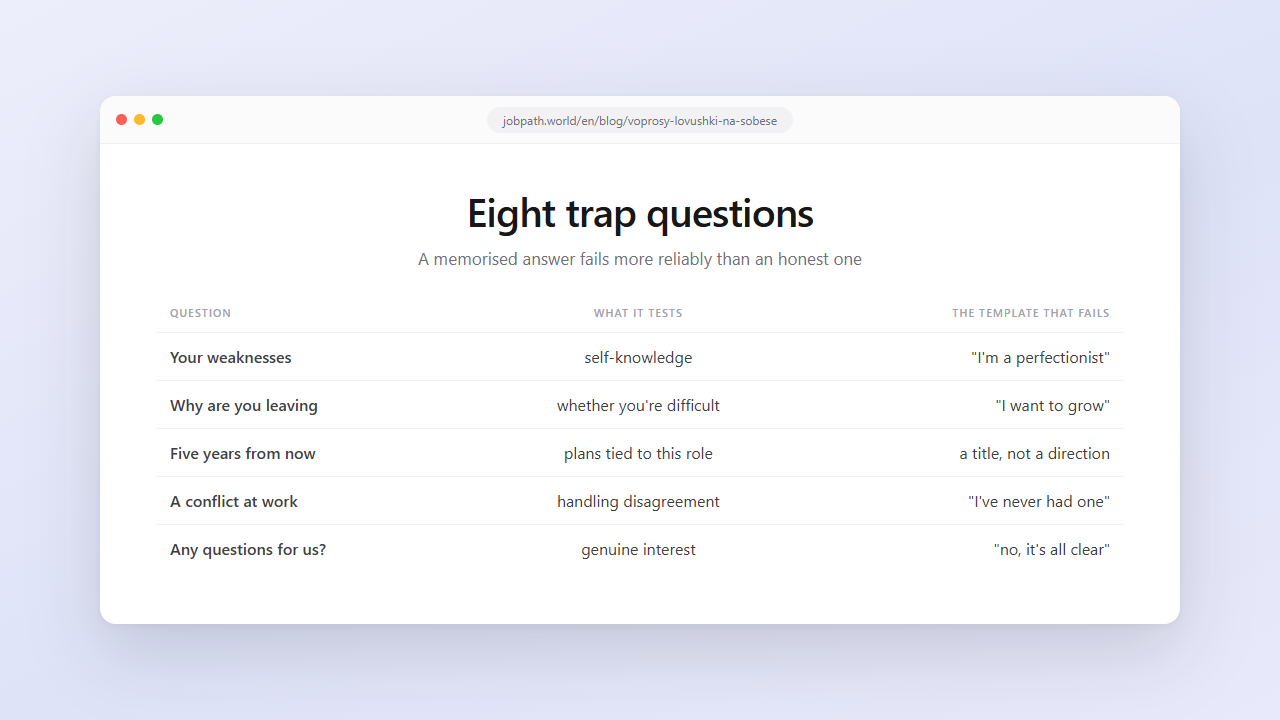
The behavioural section is the one candidates fail. It isn't "tell me about yourself" but a series of questions like "tell me about a conflict in your team and what you did". The expected shape is STAR: situation, task, action, result — with a number in the result.
Two things worth preparing and rehearsing out loud: five stories from your experience covering conflict, failure, initiative, a deadline and learning something new; and a two-minute self-introduction in English. That's what mock interviews are for — the gap between remembering a story and saying it out loud in a second language is large.
Money: where people trip
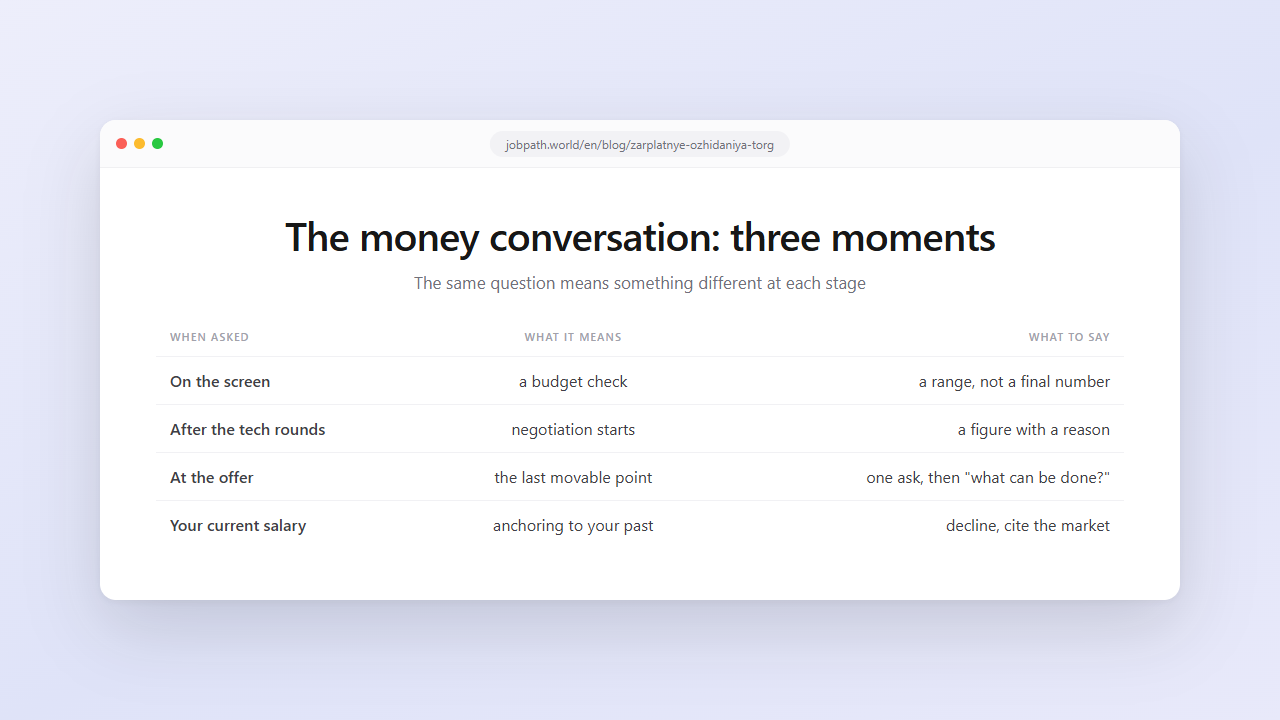
Gross, not take-home. Most countries quote annual pre-tax salary. Comparing that to a net figure from another market is meaningless — European taxes and mandatory contributions are higher.
Cost of living. €60,000 in Berlin and €60,000 in Munich are different amounts. Work out rent, tax and insurance before saying yes.
Getting paid remotely. A direct transfer to a contractor in a sanctioned or high-friction jurisdiction is the practical obstacle. Two patterns usually work: a bank account in the country where you're tax resident, and employer-of-record services that hire you locally on the client's behalf. Both have tax consequences, and this is the one place where paying an adviser once is worth it.
What doesn't work
Mass applications without work authorisation. A hundred applications to roles that ask about visa status produce a hundred automatic rejections. Filter for "visa sponsorship available" and for companies that already hire internationally.
A locally formatted resume. A photo and a bordered table read as a foreign standard, and sometimes simply don't parse.
Expecting speed. Realistically, four to nine months from first application to arrival with a visa, bureaucracy included. Remote is faster but more crowded.
Relying only on job boards. A large share of hiring at international companies runs through referrals, which lift you out of the stream exactly as they do anywhere else.
FAQ
How do I start looking for work abroad?
With the right-to-work question: it comes first in every application form and eliminates most roles. Then pick a route — visa relocation, remote work or internal transfer — rebuild your CV to the international format, and prepare for the behavioural round.
What salary do I need for a German Blue Card?
For 2026 the thresholds are €50,700 a year in general and €45,934.20 for shortage occupations, which include IT roles. Check the official source before applying; the thresholds are revised annually.
Can I get a Blue Card without a degree?
In IT, yes: at least three years of relevant professional experience in the last seven, plus an offer meeting the shortage-occupation threshold.
How long does relocation take?
Four to nine months from first application to moving: the search, several interview rounds, an offer and paperwork. Remote work takes one to three months, but competition is higher.
How does an international CV differ?
No photo, age or marital status; one page up to ten years of experience; achievements with numbers rather than a list of duties; simple single-column layout an ATS can parse. It's a different document, not a translation of your existing one.
What do candidates fail most often in western interviews?
The behavioural section. Interviewers expect STAR-shaped stories — situation, task, action, result with a number — rather than reflections about yourself. Five prepared stories cover most of that round.