AI interview assistants in Russian: where western copilots break
"Supports 50+ languages" means the model understands the question. In a Russian-language interview that isn't enough: transcription breaks on code-switched speech and answers read like translations. Here's exactly where, and how to test it.
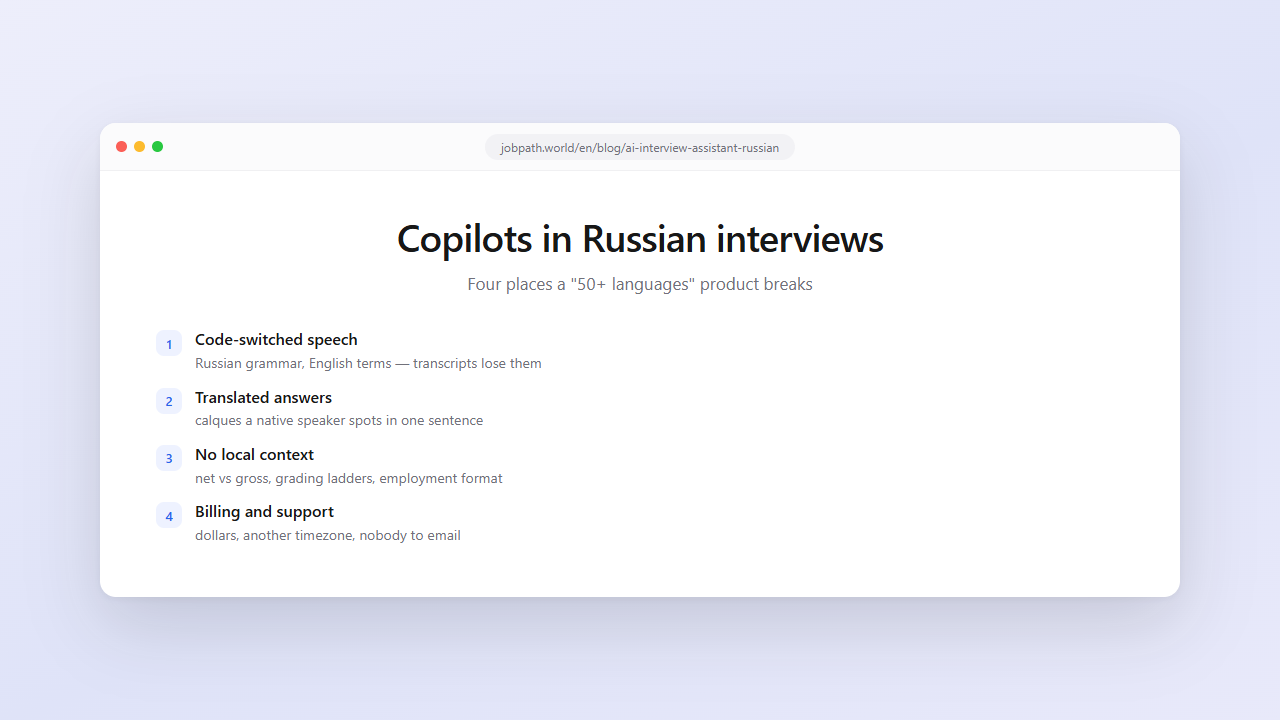
Nearly every copilot in this category advertises dozens of languages: 30+, 50+, 143. Technically that's true — large models handle Russian. But between "the model understands the language" and "the product works in a Russian-language interview" sit four specific problems, and all four surface in the first five minutes of a call.
This is a breakdown of each, plus a short test that separates products in a single evening.
Problem one: code-switched speech
Here's how a Russian-speaking engineer actually talks:
«Мы задеплоили на прод через гитлаб раннер, потом откатились, потому что на стейдже не поймали race condition в консьюмере»
One sentence with Russian grammar and English technical terms — some pronounced in Russian, some in English, and several inflected by Russian case rules: в консьюмере, задеплоили.
Speech recognition engines are tuned to one language at a time. Set to Russian, the engine mangles or drops the English terms; set to English, everything else falls apart. What reaches the model is a transcript full of holes, and the prompt comes back off-topic even though any native speaker would have understood the question instantly.
This is the main technical reason a copilot that shines in an English interview looks stupid in a Russian one. It isn't the model's intelligence — it's the step before the model.
Problem two: answers that read like translations
A model trained mostly on English-language interviews composes in English rhetoric and then translates. The tells are recognisable to any native speaker:
- «Я взволнован возможностью работать в вашей команде» — a literal calque of I'm excited about the opportunity, which nobody says in a Russian interview;
- excessive politeness formulas that sound corporate-American rather than local;
- the STAR method recited so literally that the candidate names the stages out loud;
- formal вы where the local tech industry has used informal ты for a decade, and the reverse.
Interviewers catch it immediately — not because they've detected AI, but because people don't talk like that. What else gives candidates away is its own article.
Problem three: no local hiring context
Questions that don't exist in US interviews and that a western product answers in generalities:
| Question in a Russian interview | What you need to know to answer |
|---|---|
| "Salary expectations — net or gross?" | the 13% income tax gap and how to state it |
| "We're hiring at middle-plus, you're asking for senior" | how local grading ladders are built |
| "Employment contract or self-employed status?" | tax, vacation and risk differences |
| "Why did you leave after six months?" | local norms on tenure |
| "Any experience with 1C?" | what that stack is and why it's asked |
A copilot built for American hiring answers all of it politely and beside the point. Not because it's bad — the context simply isn't in its training or its prompts.
Problem four: billing and support
Prosaic, and decisive. Dollar subscriptions don't clear on Russian cards; support answers in English in its own timezone; and if something double-charges, the company you'd need to reach isn't reachable.
How to test a copilot on Russian in one evening
You need any call where you can speak out loud — a colleague, a friend, or a recording of your own screen. Ask five questions aloud and watch four things rather than the beauty of the answer.
1. Code-switching. Say a sentence with English terms inside Russian grammar: «расскажите, как вы дебажили мемори лик в проде». Look at the transcript. If the terms are mangled, you can stop there.
2. Latency. Time the gap between the end of the question and text appearing. More than three seconds and you'll have started answering on your own in a real interview.
3. Reaction to your own voice. Say something long yourself. If the copilot starts answering your words, it isn't separating audio sources, and that will get in your way constantly.
4. Naturalness. Read the answer out loud. If a live person wouldn't phrase it that way, it's a translation and it will sound like one.
What to do if a copilot can't handle Russian
Three options, and they combine.
Use a product built for the market. Our assistant treats Russian as the product's own language rather than a translation target, and it knows the context behind the questions in the table above. It also works with the local meeting clients — Telemost and Kontur.Talk.
Prepare in advance. Half the questions in any interview are predictable. Mock interviews with a voice AI interviewer in Russian close exactly the gap a copilot can't: pacing, intonation and confidence.
Don't lean on prompts for context questions. Employment terms, grade and salary are worth deciding before the call and knowing by heart. Those are the questions that cost money, and reading them off a screen is where it shows most.
FAQ
Why does an AI copilot struggle in a Russian-language interview?
Mainly for a technical reason: speech recognition is tuned to a single language, while local professionals speak in a mix — Russian grammar with English technical terms. Those terms get dropped or mangled, so the model receives a transcript with holes. The second reason is answers composed in English rhetoric and translated afterwards.
Which AI interview assistant works best in Russian?
One where Russian is the product's primary language rather than an entry in a list. The practical test: try a code-switched sentence with English terms and inspect the transcript. Products built for English-language hiring stumble exactly there.
Do western copilots understand Russian at all?
They do — the 30 to 143 advertised languages are real, and large models know Russian. The failure isn't comprehension, it's transcribing mixed speech and missing local hiring context such as grading ladders, employment formats and net-versus-gross salary.
How should I evaluate a copilot before buying?
On a free tier, during a live call. Ask five typical questions aloud and score four things: transcription quality on code-switched speech, latency before the answer, whether the product reacts to your own voice, and whether the phrasing sounds like a person.
Can I use a copilot if I speak English with an accent?
Yes, though recognition accuracy drops — that's a weakness of every engine. Practical tip: speak slightly slower for the first minutes until you've confirmed the transcript is coming through cleanly.
What matters more, the copilot or preparation?
Preparation. A copilot gives you structure, but you do the talking, and the difference between understanding and reading aloud is audible. Mock interviews before the call plus a prompt during it works noticeably better than either half alone.