The recruiter screen: 20 questions and what each one is really testing
A recruiter usually can't judge your engineering. They can absolutely cut you — on money, timing, motivation and inconsistencies in your story. Twenty questions, what each tests, and the answers that end the call.
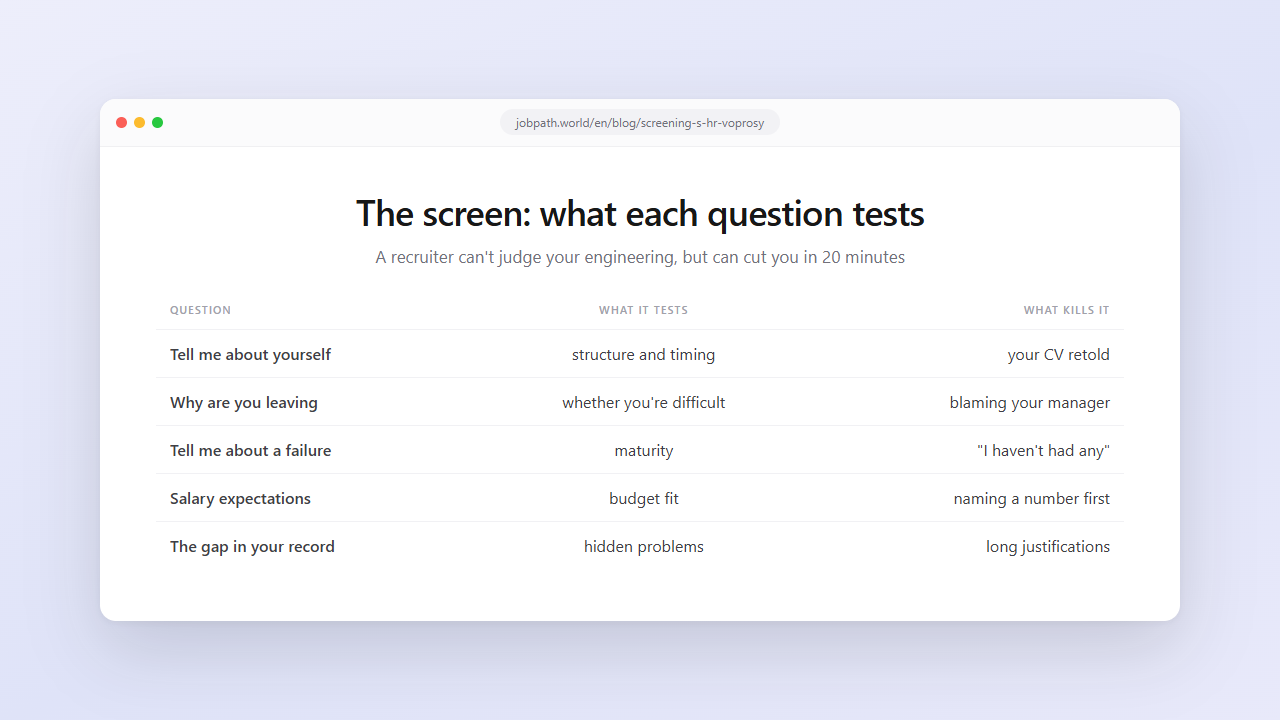
The first call runs twenty to thirty minutes, and its role is widely misunderstood. A recruiter usually can't assess whether you're a good engineer — that's what the technical round is for. What they can do is cut you: on compensation, on start dates, on motivation, and on inconsistencies in your story.
So a screen isn't an exam, it's a reconciliation. Here are the twenty questions that show up and what sits behind each.
Block 1: introductions
| Question | What it tests | What kills the answer |
|---|---|---|
| Tell me about yourself | whether you can structure and keep time | your CV retold from your first job |
| Why did you apply to us | whether you read the posting | "looking for new opportunities" |
| What do you know about the company | whether you spent five minutes | "honestly, nothing" |
The first question decides more than the rest: it frames the whole conversation. Two minutes, three parts — who you are professionally, what you've done in the last couple of years, why this role. A trailer, not a biography. Building the self-introduction is its own topic, but the rule is simple: end on why you're here.
Block 2: motivation and leaving
| Question | What it tests | What kills the answer |
|---|---|---|
| Why are you leaving your current role | whether you're difficult | criticising your former manager |
| What doesn't work for you now | whether their reality matches | "nothing, I'm just looking" |
| What do you want from a new role | whether they can provide it | a list of ten requirements |
| Where do you see yourself in three years | whether your plans involve this job | "hard to say" |
This is where people lose for no reason. The working formula is "moving towards, not away from": name one real reason neutrally and pivot immediately to what you're looking for. "The project shipped and moved to maintenance — I want to build from scratch again" is fine. "My manager is an idiot" ends the call even when it's true.
If you're genuinely leaving over money, say so. It's a normal, respected reason, and hiding it creates an inconsistency people can hear.
Block 3: experience
| Question | What it tests | What kills the answer |
|---|---|---|
| Tell me about your last project | whether you can explain complexity simply | ten minutes of detail with no point |
| What was your role | your contribution versus the team's | "we" all the way through |
| Your hardest problem | scale and how you think | "nothing was really hard" |
| Tell me about a failure | maturity and whether you draw conclusions | "I haven't had any" |
The failure question comes up nearly always, and "I haven't had any" reads as either no experience or no reflection. The working shape: what happened, what you did, what you changed afterwards. No self-flagellation, no blame-shifting.
It pays to prepare five stories in advance — conflict, failure, initiative, a deadline, learning something new — and say them out loud. The same stories cover half the questions in every round if you lay them out in STAR shape.
Block 4: logistics, where money gets lost
| Question | What it tests | What kills the answer |
|---|---|---|
| Salary expectations | whether you fit the budget | naming a number first with no data |
| When could you start | how urgent the role is | "tomorrow" while employed |
| Office, hybrid or remote | fit with their policy | agreeing to everything at once |
| Do you have other offers | your market value and their timeline | inventing an offer |
| Are you comfortable with a probation period | whether you understand the terms | not asking what the terms are |
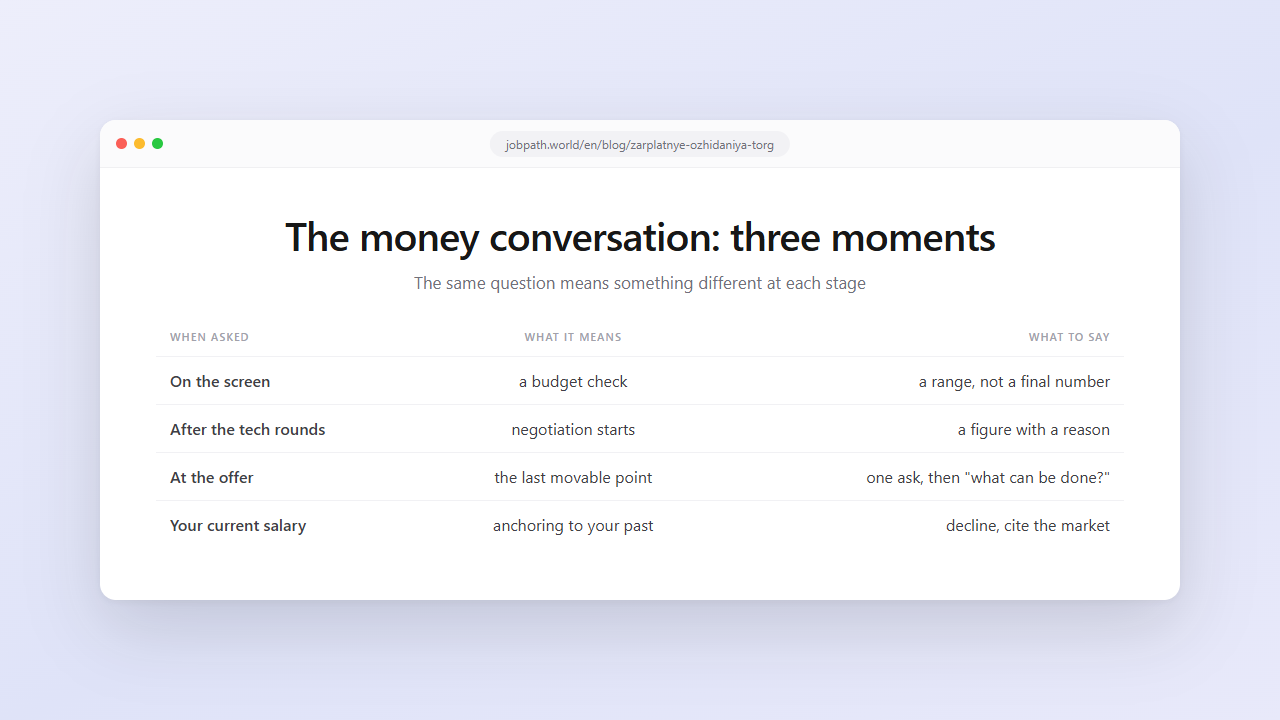
The salary question is the most expensive minute of the call. The good move is to ask for their range first: "What's the budget for this role?" is a normal counter-question that saves both sides time. If they won't say, give a range of your own, anchored in market data rather than in your current salary.
On inventing offers: don't. One follow-up question about your decision timeline exposes it.
Block 5: risk-check questions
| Question | What it tests | What kills the answer |
|---|---|---|
| Why the gap in your record | whether something is hidden | tangled explanations and evasion |
| Why so many job changes | whether you'll stay | blaming every previous employer |
| Why did you leave after six months | what happened there | "personality differences" |
| What did you do during the break | whether you fell out of the field | "rested" |
These aren't traps. The recruiter is closing a risk, and a calm one-line explanation satisfies them. The shorter and flatter the answer, the faster the topic closes; the longer you justify, the more attention it attracts.
Three questions worth asking back
The screen runs both ways, and two questions here save weeks.
"Is this a new role or a replacement?" If it's a replacement, ask what happened to the previous person.
"What does the rest of the process look like, and how many stages?" Five rounds with a weekend take-home is information you need before investing.
"What's the budget for this role?" Early rather than late — passing four stages and parting over a number is an avoidable waste.
The answers usually say more about a company than the job ad does.
How to prepare
The screen is the most predictable stage there is: the questions repeat almost word for word between companies. Which leads to a practical conclusion — rehearse it out loud once instead of reading about it.
The wording still drifts between companies. Before rehearsing, it helps to see it through someone else's eyes: in the question bank the behavioural section sits apart from the technical one and filters by company.
The gap between knowing your answer and having said it out loud is large; pacing, pauses and the habit of drifting into detail only show up live. Mock interviews with a voice AI interviewer cover exactly that: same questions, same format, none of the cost.
FAQ
What do recruiters ask in a screening call?
Three blocks: introductions and motivation (tell me about yourself, why us, why are you leaving), a brief pass over your experience, and logistics — salary expectations, start date, work format. Technical questions rarely appear at this stage.
How long does a recruiter screen last?
Twenty to thirty minutes. Running past forty is usually a good sign: the recruiter has switched from checking boxes to selling you the role.
Should I name my salary expectations first?
Ask for their range first — it's a normal counter-question. If they won't share, give a range of your own based on market data rather than your current salary.
How do I answer "why are you leaving"?
One neutral reason in "moving towards, not away from" form: what finished at your current role and what you're looking for next. Criticising a former manager ends a call faster than any technical failure.
What do I say about a failure?
A real story with a shape: what happened, what you did, what you changed afterwards. "I haven't had any failures" reads as no experience or no reflection.
Can a recruiter reject me without a technical interview?
Yes, and it's the most common outcome: mismatched salary expectations, start dates, work format, or inconsistencies in the story. The screen isn't a formality — it has the highest drop-off of any stage.