Free AI interview assistant: what a $0 plan actually gives you
"Free" means four different things on copilot websites — a live copilot, preparation only, a download, or nothing at all. Here's who gives what, and how to get through an interview on zero.
On copilot websites the word "free" covers four different offers, and the difference between them is the difference between testing a product in a real interview and wasting an evening. Here's what each includes as of 1 September 2026, and how to get through an interview without paying.
What each free tier includes
| Service | What you get for free |
|---|---|
| JobPath | 15 minutes of the assistant a month and 15 auto-applications a day |
| ParakeetAI | 10 sessions |
| Sensei AI | 15-minute copilot sessions + resume builder |
| Verve AI | 3 copilot sessions, 5 mock interviews, 14 resume-side tools |
| LockedIn AI | start without a card, volume unspecified |
| Final Round AI | preparation: resume, job description parsing, checklist. No copilot |
| Interview Coder | the download only; AI features don't run |
| Sobes.tech | no free tier |
The important distinction is in the last few rows. Final Round AI's free plan excludes the live copilot, so you can't see how the product behaves on a real call — its latency, whether it catches the point of a question — until you've paid.
The second distinction is one-off versus recurring. Verve AI's three sessions are gone after your third interview, permanently. Our 15 minutes renew every month, so the free tier covers one key interview a month for the whole search, as long as you stay inside a quarter of an hour per call.
How to spend 15 minutes across an hour-long interview
Fifteen minutes sounds thin until you look at how a call is actually structured. An interview isn't uniform: some stretches make a prompt useless, and two or three moments decide the outcome.
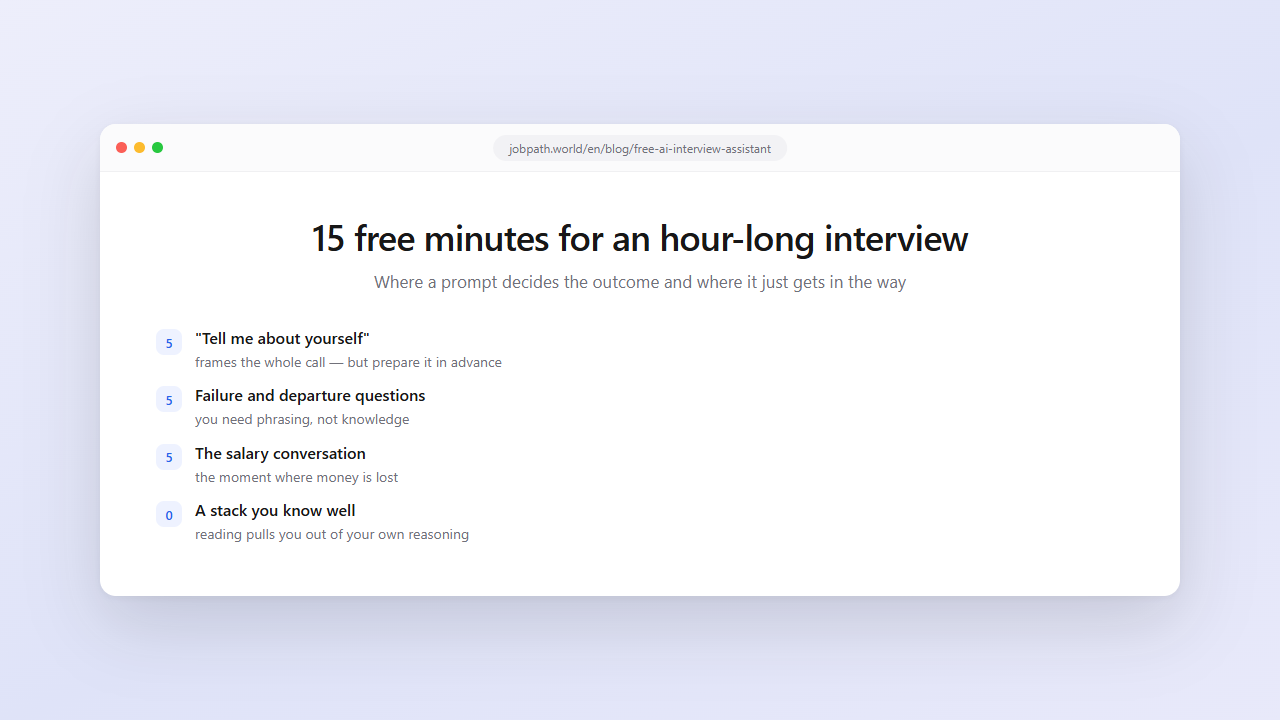
First 5 minutes — "tell me about yourself." The most predictable and most underrated part. A prompt helps most here because it frames the whole conversation. It's also the easiest part to prepare in advance — build the self-introduction beforehand and don't spend the allowance on it.
Middle, 20–30 minutes — experience questions. Selective help. You already know the answers about your own projects; it's "tell me about your biggest failure" and "why are you leaving" where a phrasing suggestion earns its place. Call it five minutes.
Technical block. On a stack you know, a prompt gets in the way — reading pulls you out of your own reasoning. On an unfamiliar one, that's exactly when you want it.
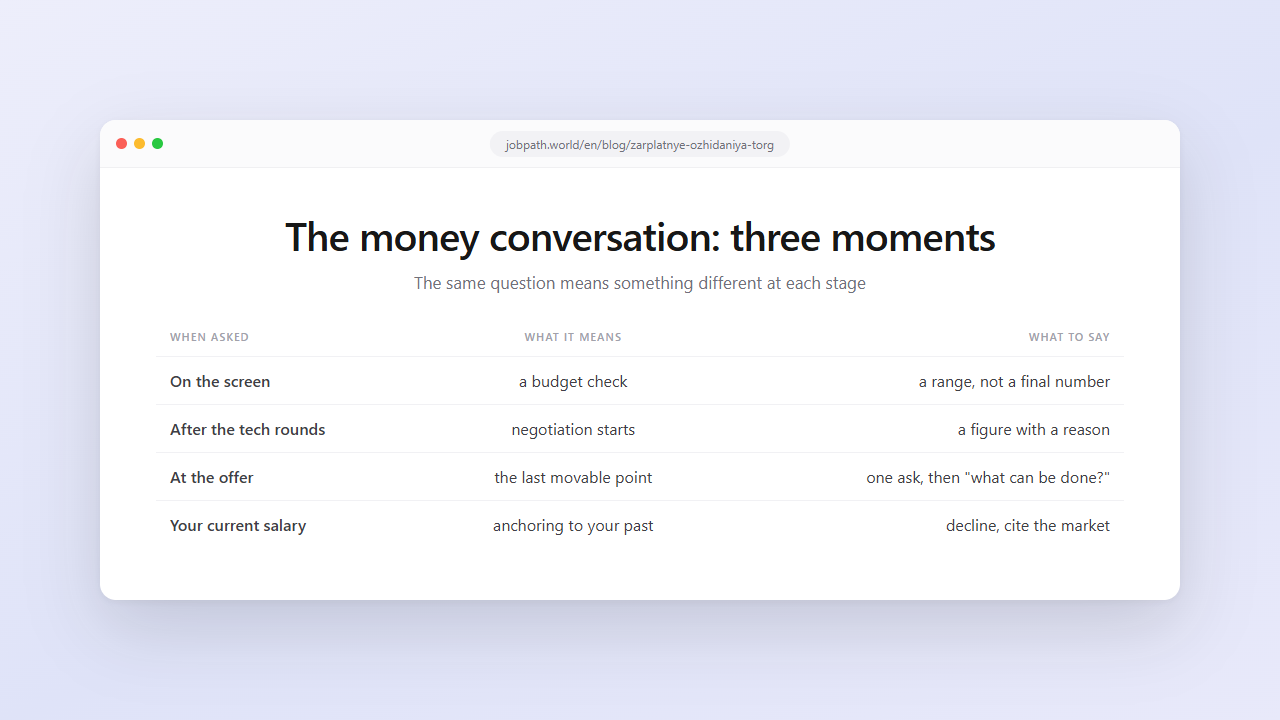
The end: your questions and salary. The moment where money is lost. Five minutes of the allowance spent on the compensation conversation pays back more than the rest combined.
Five minutes on hard experience questions, five on unfamiliar tech, five on salary. Fifteen minutes covers an interview as long as you don't leave the prompt running the whole hour.
What to do when the free allowance runs out
Prepare instead of peeking. Half the questions in any interview repeat. Mock interviews give you what a prompt can't: the habit of speaking out loud under someone else's gaze. After three sessions you reach for the prompt noticeably less.
Keep a cheat sheet on a second screen. Not full answers — those are audible — but ten lines: numbers from your projects, system names, your salary range, two or three prepared stories. Unlike a copilot, you can glance at it without a three-second delay.
Don't try to replace a copilot with a chatbot on your phone. The plan falls apart for three reasons: typing the question takes longer than answering it, looking at a phone is visible, and the answer arrives with no context from your resume or the job ad.
Record the interview and review it. Even a failed one can be taken apart afterwards: write down every question you stumbled on within the hour, while you still remember the wording. It's free and it works better than any allowance.
The free things around the interview
Most of the attention goes to live prompts, while the most useful free part is usually elsewhere.
Applications. Our free tier includes 15 automatic applications a day — 450 a month, more than most people send by hand across an entire search — running inside your own job-board account.
Resume analysis. Running your resume through an ATS check costs nothing and often explains the silence.
Telegram job feed. A feed of channel postings with recruiter contacts; some of those roles never reach the job boards.
Should you pay at all
It depends on where you're stuck.
If you get interviews but don't pass them, a paid copilot and mock interviews pay for themselves with the first offer — the difference a decent salary conversation makes usually exceeds a year of subscription.
If you don't get invited at all, no copilot helps, free or paid. The problem is upstream: the resume, the relevance of your applications and their volume.
If you have one interview coming up, fifteen free minutes a month is enough. Don't pay.
FAQ
Is there a completely free AI interview assistant?
No product in this category is entirely free, but several include live sessions in the free tier: JobPath gives 15 minutes of the assistant a month, ParakeetAI 10 sessions, Sensei AI 15-minute sessions, and Verve AI 3 copilot sessions plus 5 mock interviews.
Are 15 minutes enough for an interview?
Yes, if you don't leave the prompt running for the full hour. An interview isn't uniform: prompts matter on failure and departure questions, on unfamiliar technology, and during the salary conversation — roughly fifteen minutes in total.
Which service has the best free tier?
It depends on what you need. ParakeetAI gives the most live sessions up front (10 sessions). JobPath's allowance is smaller, 15 minutes a month, but it renews every month, and 15 automatic applications a day come with it for free. Packs of 3 or 10 sessions run out mid-search and don't come back.
Can I use ChatGPT instead of a copilot during an interview?
Technically yes, practically poorly: typing the question takes longer than the interviewer will wait, glancing at a phone is visible, and the answer comes without the context of your resume or the job ad. It's an excellent preparation tool and a bad live one.
Why doesn't Final Round AI's free plan include the copilot?
That's how their offer is built: resume upload, job description parsing and a prep checklist are free, while live sessions require Pro. The practical consequence is that you can't evaluate the main feature before paying.
What free tool helps more than prompts?
Resume analysis and application volume. If no invitations arrive, a live prompt is irrelevant — you never reach the call. A free ATS check and 15 automatic applications a day move the funnel more.