The best AI interview copilot: 7 criteria and a winner per scenario
"Best" depends on the scenario here more than in almost any other software category. How a copilot works inside, the seven parameters that actually change the outcome, and who wins in each situation.
An AI interview copilot is an app that listens to the interviewer's question through system audio, transcribes it, sends it to a language model along with your resume, and displays a ready answer in a window the operating system keeps out of screen capture.
That's the whole category. Everything else is detail — and the details decide whether the product helps you or gets in your way.
How it works inside
Understanding the pipeline saves money, because nearly every difference between products grows out of it.
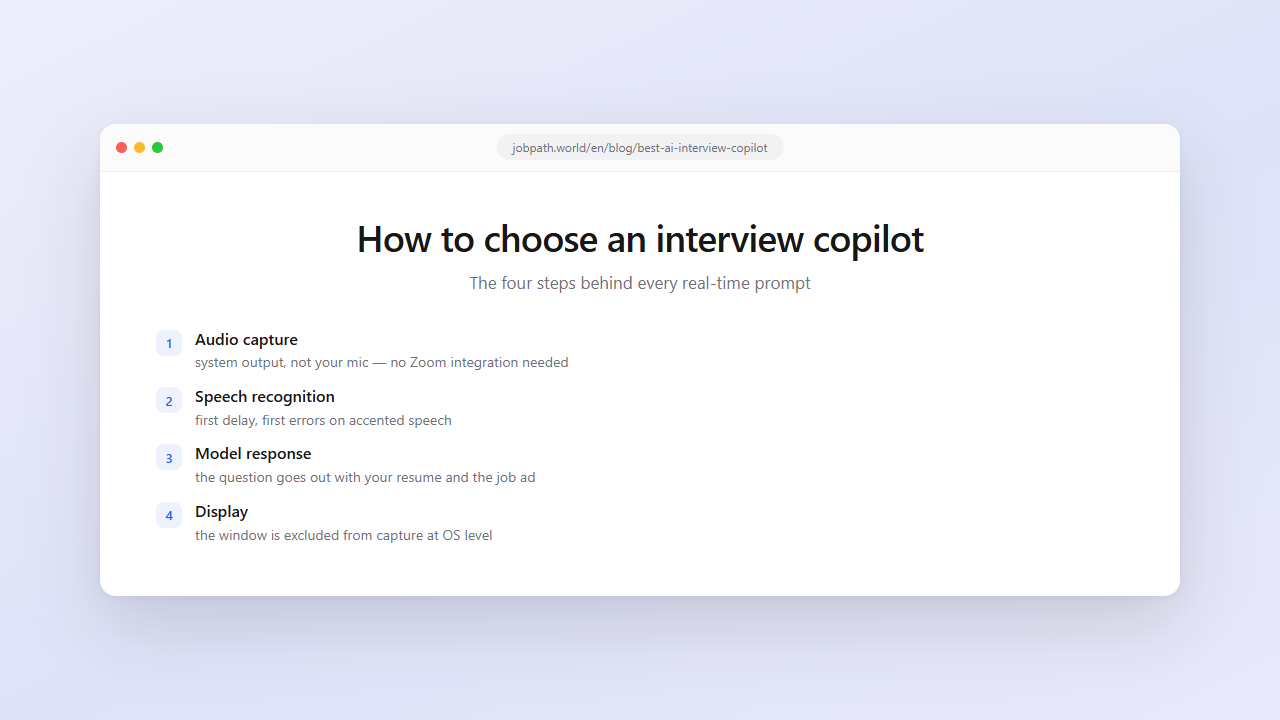
- Audio capture. The app listens to system output — what the other person is saying — not your microphone. Which is why a copilot needs no integration with Zoom or Meet: it works the same with any client.
- Speech recognition. Speech becomes text. Here's the first delay and the first source of error: accented speech or a poor microphone transcribes worse.
- Model response. The question goes to a model together with context — your resume, the job description, sometimes an industry knowledge pack. Second delay.
- Display. The answer appears in a window excluded from screen capture.
Total latency from the end of the question to text on screen runs from one to five seconds. It's the single most practical parameter, and marketing pages almost never state it honestly.
Seven criteria that actually matter
1. Latency. If the answer lands four seconds late, you've already started talking — and the prompt breaks your train of thought instead of supporting it. You can only measure it on a live call, which makes a free tier with a real session more useful than any review.
2. Whose audio it hears. A good copilot separates the interviewer's speech from yours. A bad one reacts to your own words and starts answering them.
3. What the window does during screen share. OS-level filtering is a real mechanism and most serious products have it. Promises of "complete undetectability" are marketing: behaviour is what exposes people, not software.
4. Credits or unlimited. The credit model looks flexible until you learn that every rephrasing and every failed debugging attempt costs one. Counting your balance mid-interview is a bad place to be.
5. A free test on a live call. Some products give away preparation only and keep the copilot behind the paywall — meaning the first time you see it in action, you've already paid.
6. Language and market. "50 languages supported" means the model will understand the question. It's not the same as knowing the market: local grading ladders, how job ads are written, what recruiters in your country actually ask.
7. What surrounds the call. A copilot switches on once an interview is booked. If you're not getting invited at all, the problem sits upstream, and no copilot addresses it.
Winners by scenario
| Scenario | Pick | Why |
|---|---|---|
| Interviews in Russian | JobPath | built for that market, local billing |
| You need the search and the call | JobPath | applications and resume tools in one place |
| Algorithmic rounds | Interview Coder | purpose-built for on-screen problems |
| An uncommon interview language | Final Round AI | 143 languages advertised |
| Phone screens | LockedIn AI | a dedicated mode plus mobile apps |
| All calls, not just hiring | ParakeetAI | positioned beyond interviews |
| Cheapest entry | JobPath | 15 free minutes a month, then from ~$12 a month |
Prices and detail for each are in the six-alternative breakdown.
What no copilot will do
Replace understanding. A prompt gives you structure. If you don't understand what you're reading, it's audible — reading has a different cadence from explaining, and experienced interviewers catch it.
Pass a discussed coding round for you. You can get the solution. Explaining why that algorithm and answering "what happens at a million rows" is still on you.
Fix your funnel. If a hundred applications produce zero invitations, interviews aren't your problem — you never reach them. Resume analysis and better applications are what move that.
Give you confidence. The pattern we see in our own users is counterintuitive: the better prepared someone is, the less they look at the prompt and the more it helps — as a safety net rather than a crutch. Which is why mock interviews beforehand improve copilot results more than any model setting.
How to test a copilot in one evening
Take the free tier, start a call with a friend or record your own screen, and ask five standard questions out loud: tell me about yourself, why are you leaving, your hardest project, your weaknesses, and one technical question about your stack.
Watch three things: how many seconds until the answer appeared, whether it addressed the actual question, and whether the copilot started answering your own words. That's enough to eliminate half the market before paying anyone.
FAQ
What is an AI interview copilot?
An app that listens to the interviewer's question through system audio, transcribes it, sends it to a language model along with your resume, and shows a ready answer in a window excluded from screen capture. No integration with Zoom, Meet or Teams is required.
Which interview copilot is best in 2026?
There's no universal best — the category is narrow and the scenarios differ. JobPath fits Russian-language interviews and the search-plus-call combination, Interview Coder fits algorithmic rounds, Final Round AI fits uncommon languages, LockedIn AI fits phone screens.
What should I check first?
Latency, and whether you can test on a live call for free. Everything else — language, price, feature list — is readable on a website. Latency isn't; it only shows up in a real interview.
Credits or an unlimited subscription?
Unlimited is calmer. On credits, every rephrasing and every failed attempt costs you, and one hard problem can eat a visible share of the monthly pack.
Will the interviewer notice the copilot?
The window is excluded from screen sharing, and that mechanism works. What exposes candidates is behaviour: identical pauses before answers, eyes tracking sideways, the flat delivery of reading. No product covers that, which is why preparation still matters.
Will a copilot help if nobody invites me to interviews?
No. A copilot starts on the call, while "nobody invites me" is a problem in your resume, the relevance of your applications and their volume. Fix that part first.