JobPath vs Sensei AI: three differences that decide it
Of all the western copilots, Sensei AI looks most like us: both have a free entry point (15-minute sessions there, 15 minutes a month here) and similar resume tooling. Which makes the feature table boring and the details interesting — price, lock-in, and the promises one of us makes and the other won't.
Sensei AI is the closest match to JobPath in shape. Live answers, a free tier with 15-minute sessions, resume tooling, a practice mode — nearly all of it overlaps. So the interesting comparison isn't a table of ticks in both columns. It's the three places where the products actually diverge: price, the market each was built for, and what each one promises.
Facts from their site, checked on 1 September 2026.
What they have in common
Both listen to the interviewer through system audio and put an answer on your screen. Neither integrates with the meeting service, so both work identically in Zoom, Teams, Meet or anything else. Both have a free entry point: Sensei AI gives 15-minute copilot sessions plus an AI resume builder, we give 15 minutes of the assistant a month and 15 automatic applications a day.
Both tailor answers to your resume, so the prompt stops being generic. Both help with coding questions. Both have a practice mode.
Then they part ways.
Difference one: price and lock-in
Sensei AI's PRO plan is $89 a month billed monthly, or $24 a month billed annually — a 3.7x spread. The attractive number in the marketing is only available if you pay a year up front.
JobPath Premium is 2,499 ₽ a month (about $31) monthly, and 1,499 ₽ (about $19) on annual billing. The spread between modes is 1.7x.
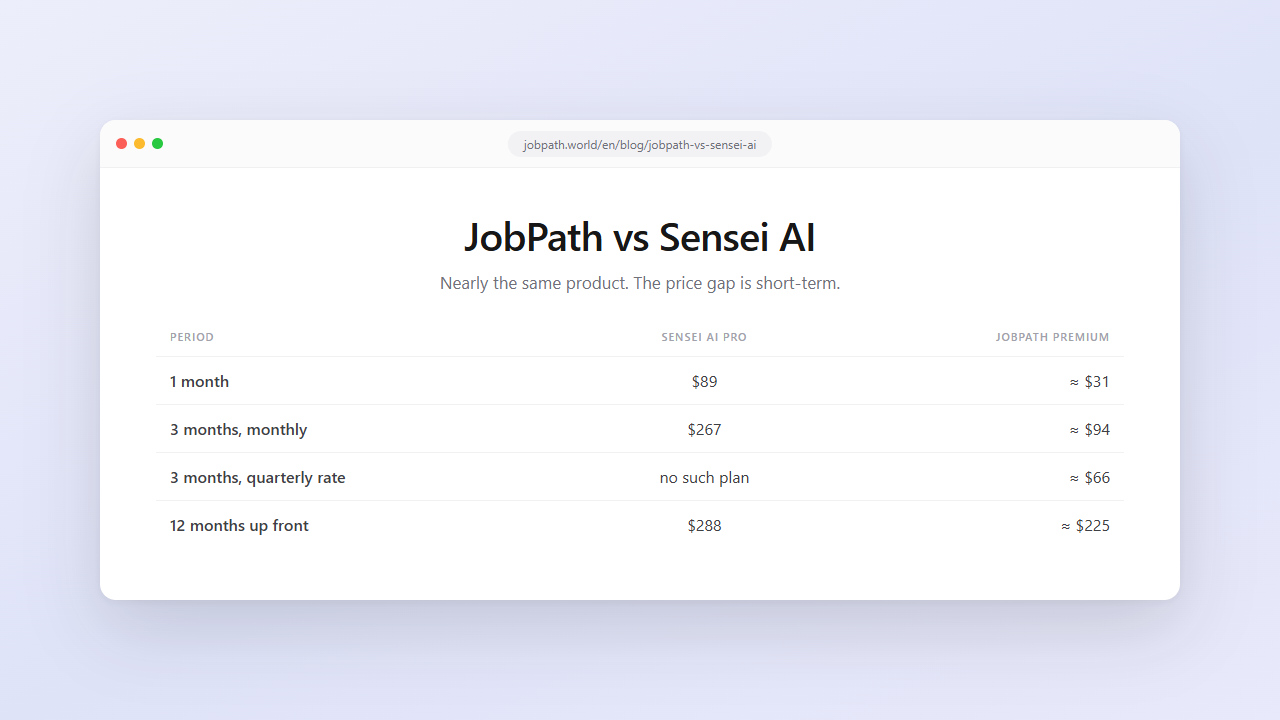
This matters because a job search rarely lasts a year. Two to three months is typical. Compared over a realistic period rather than the annual shop window:
| Period | Sensei AI PRO | JobPath Premium |
|---|---|---|
| 1 month | $89 | ≈ $31 |
| 3 months, billed monthly | $267 | ≈ $94 |
| 3 months, quarterly rate | no such plan | ≈ $66 |
| 12 months up front | $288 | ≈ $225 |
The annual prices are close. The short-term prices are not, and short term is how most people actually buy.
Difference two: the market each was built for
Sensei AI advertises 30+ languages and industry knowledge packs. A model that broad will handle a technical question in most of them.
But an interview isn't only a language. It's grading ladders that are named differently in different markets, questions about employment terms and gaps in your record, and an industry context where half the local job ads name tools a US-trained product has never heard of. Something built for American hiring answers those in generalities — not because it's bad, but because that wasn't the job.
The reverse is equally true: if you're interviewing in Portuguese or German, our two languages against their thirty is not an argument in our favour.
Difference three: what each one promises
Sensei AI's site says the product is "fully undetectable and unnoticeable by interviewers across all types of interviews."
We don't write that and we won't. Our assistant's window genuinely is filtered out of screen capture at the OS level — that's a technical fact you can verify in a minute. But "fully undetectable" is a promise about a human being, not about software, and it can't be kept.
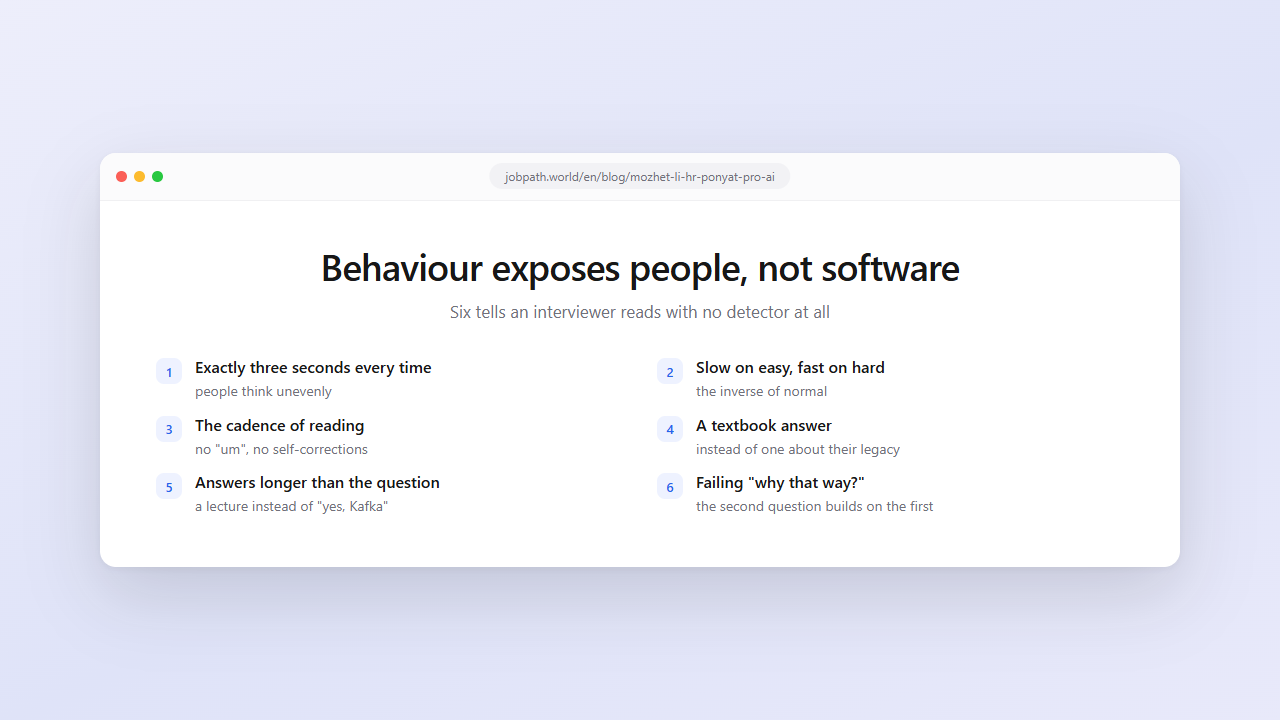
What exposes a candidate is behaviour: the same pause before every answer, eyes drifting sideways, the flat cadence of reading, an answer to a slightly different question than the one asked. We go through it in detail in a separate article. No program closes that gap — preparation does, which is why our mock interviews sit next to the assistant rather than in some other section.
What we have that they don't
Sensei AI starts when the call starts. Before the call there are hundreds of applications, and that's the most exhausting part of the search. Our automatic applications run inside your own job-board account, and there's a feed of jobs pulled from Telegram channels with direct contacts.
Plus details that turn out not to be details: a Linux build (still a beta without hidden mode, which works on Windows and macOS) and local payment methods.
Who should pick what
Sensei AI if you interview in a language we don't cover, you're comfortable with dollar billing, and you don't need the application side.
JobPath if you want the short-term price to be sane, and if applications, resumes and cover letters are as much of a problem as the interview itself.
Both hypotheses are free to test — each product has a no-card tier. Start there: fifteen minutes on a real call tells you more than an hour of reading reviews.
FAQ
How much does Sensei AI cost?
The free plan is $0 and includes 15-minute copilot sessions and an AI resume builder. PRO is $89 per month billed monthly, or $24 per month billed annually. Checked 1 September 2026.
What's the difference between JobPath and Sensei AI?
Three things: the short-term price ($89 for a month against roughly $31), the market each product is built for, and coverage — we add automatic applications, a Telegram job feed and a full resume toolkit.
Is an interview copilot really undetectable?
The window can be kept out of screen capture; that part is real. "Fully undetectable" is a promise no product can keep, because what gives candidates away is behaviour rather than software. We don't use that wording.
Which free tier is better?
They're close. Sensei AI gives 15-minute copilot sessions and a resume builder. JobPath gives 15 minutes of the assistant a month plus 15 automatic applications a day, so the free tier covers searching as well as the call.
Does Sensei AI support Russian?
They advertise 30+ languages, so the model will understand the question. Knowing the local hiring market is a separate matter — job ad conventions, grading ladders and standard recruiter questions differ, and a product built for that market answers more precisely.
Do these copilots work in Zoom and Google Meet?
Yes, both. Neither integrates with the meeting service: the app listens to system audio and draws its own window on top, so the call client is irrelevant.