Pramp, Interviewing.io and JobPath: which one actually helps
Three tools, three jobs. Pramp forces you to think out loud under pressure. Interviewing.io rents you a Stripe engineer for $225 per session. JobPath does something stranger: whispers an answer into your ear while you're being asked. Here's where each one actually fits.
By 2026, anyone serious about a tech job has a folder of bookmarks for interview prep services. They all promise the same thing — getting you through the technical part of an interview. In practice, they do completely different things.
Over the last month I sat through three formats. Once on Pramp with a stranger from Bangalore, both of us grilling each other on binary tree problems. Once on Interviewing.io for $225, paired anonymously with a Stripe engineer who roasted my system design. And once on a real screening at a YC-backed Series B, with JobPath quietly surfacing answers in the corner of my screen. All three were useful in completely different ways. Comparing them on "better/worse" misses the point. The right question is which one fits which situation.
Pramp: free, and worth every minute
Pramp is peer mock interviews. You sign up, book a slot, get matched with another candidate. One hour: you interview them on a random problem from the pool, then you swap. Browser whiteboard, code sharing, video.
What Pramp gives you is the habit of thinking out loud in front of another human being. You can solve the same problem in your head in ten minutes. Explaining it to a stranger with an accent who's hearing your reasoning for the first time takes forty minutes and leaves your back sweating. That's the training effect. You build the muscle for pacing, framing, hedging, the small things like "let me handle the empty array edge case first, then the main algorithm."
Where Pramp falls flat. Your partner is another candidate, not a hiring engineer. Get matched with a first-year CS student and the feedback is "you took kind of a long time, maybe go faster." You won't get the deep critique that catches you handwaving past O(n²) or missing a critical boundary case. The problem pool also leans heavily LeetCode-style: algorithms, data structures, light system design. For behavioral, frontend architecture, ML interviews, or domain-heavy rounds, Pramp doesn't have the format.
Cost: nothing. Match-time is five to ten minutes during peak hours, longer at night. The platform is English-only, and so is the conversation, which is actually a hidden bonus if you're a non-native speaker preparing for international interviews.
Take Pramp if: you're a student or junior, prepping for coding rounds, and you want a free way to get used to talking under pressure on camera. Ten to twenty sessions before serious interviews kills most of the "what if I freeze" anxiety.
Interviewing.io: premium for FAANG aspirants
Completely different model. Here you're paired with an actual senior or staff engineer from Google, Meta, Stripe, Airbnb, Netflix. Anonymous: the company you might apply to never knows it was you, so a bad session has zero cost. Sessions are recorded, and afterwards you get a written breakdown — what landed, what didn't, which specific phrasing tanked the impression.
Cost: $225 per single session, packages from $400/month. For a US engineer's salary, it's a couple of dinners. For someone interviewing in Eastern Europe or Asia, it's serious money.
What you're really buying is calibration. After two or three sessions you understand what level of communication and structuring is expected at a Google bar-raiser round. That's knowledge transfer from someone who runs twenty interview loops a year and has watched hundreds of candidates fail and succeed. Pramp can't give you that, period.
Where Interviewing.io doesn't fit. English only, FAANG-flavored. If you're targeting non-US tech companies — Yandex, Avito, Stripe in Dublin — their feedback frame won't translate cleanly. This is a premium tool for a specific job: getting into a top US tech company.
Adjacent paid options people sometimes mention: Interview Kickstart, Exponent, IGotAnOffer. All in the same expensive, time-intensive, FAANG-pipeline-optimized bucket. If that's not your goal, don't spend the money.
Take Interviewing.io if: you're senior or staff, actively chasing Bay Area roles, have a $1000-2000 prep budget, and need real signal from someone in your target company.
JobPath: helps during the actual interview
This one's structurally different. Pramp and Interviewing.io train you before the interview. JobPath works during it.
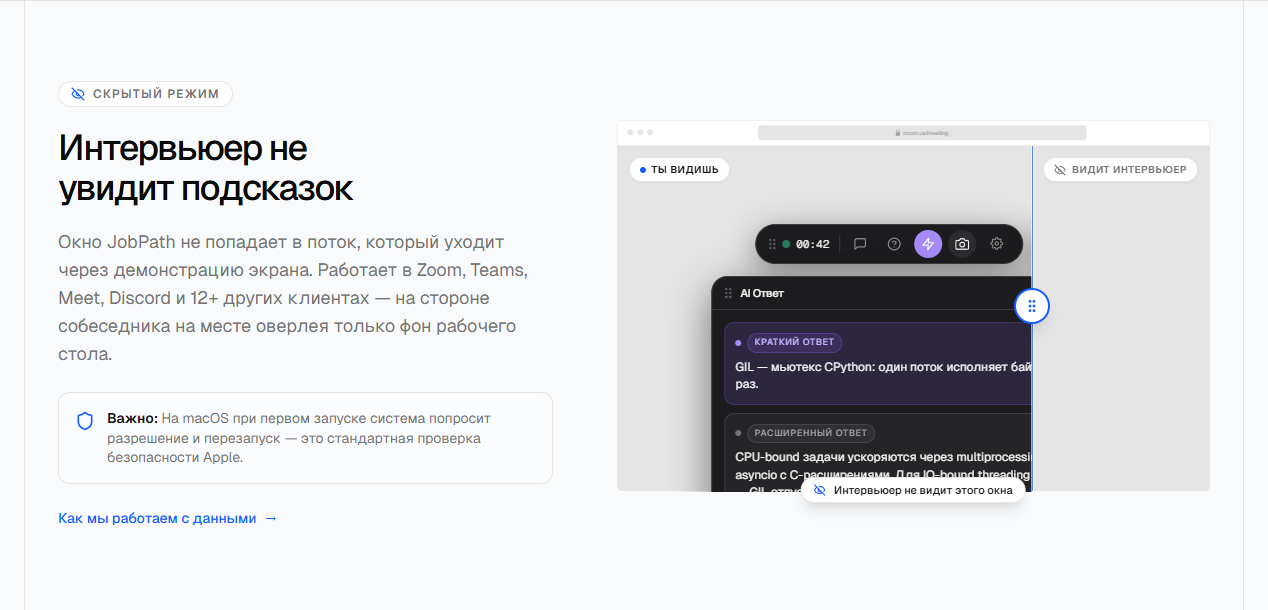
Setup: install a desktop app (Windows, macOS, Linux), launch it before the call. The window is invisible during screen-share — it's filtered out of the screen-capture API and doesn't show in screenshots either. Press a hotkey, JobPath listens to the conversation, picks the last question asked, and surfaces a structured answer in one to two seconds. There's a short version and a longer breakdown if you have time to read.
Where it saves you. They ask about a niche tech you mentioned on your resume two years ago — Erlang, Haskell, some obscure DB. They ask domain-specific things ("how do you usually handle X in fintech?"). You're running a streak of ten interviews in a week and don't have time to deep-prep for each one.
Where it doesn't. If you don't have any baseline knowledge, JobPath gives you a perfect answer, but you can't deliver it. The hint has to be unrolled into your own words in real time. Reading it off the screen gets caught immediately by tone alone.
The ethical part, plainly. Some companies don't approve. A few explicitly ban "AI assistants" in their interview policies. That's a personal call you have to make. The parallel I'd draw is calculators in school exams: ten years ago, cheating; today, standard. AI in interviews is on the same curve, the market's just earlier in it.
Pricing. Free plan gives you 15 minutes of AI-copilot per day — enough for one important interview. Basic is 999 ₽/month (about $12). Premium is 2,499 ₽/month (about $31) and adds auto-apply on job boards (separate story, but if you spend two hours a day clicking apply on listings, it pays itself back fast).
The questions database — 13,000+ real interview questions sorted by company and seniority — is free regardless of plan, for studying ahead of time.
Take JobPath if: you're in active job search, two or three interviews a day, getting hit with weird questions, and want a safety net for when something niche comes up. Or if your application throughput on job boards is killing you.
What fits which situation
Three plain scenarios.
Student or junior, zero budget. Pramp plus JobPath Free for the single most important interview that month. Practice talking out loud, build the rep on problems, run JobPath as backup on the live call.
Mid-level engineer running an active search. JobPath Premium. Auto-apply offloads the grunt work, AI hints save you when topics drift, the question bank covers theory. Pramp optionally if you want extra reps speaking under pressure.
Senior+ targeting FAANG. Interviewing.io for 5-10 sessions before the loop, JobPath as a backup on the actual onsite if you hit a niche question, skip Pramp — your level outgrew it.
One-table summary
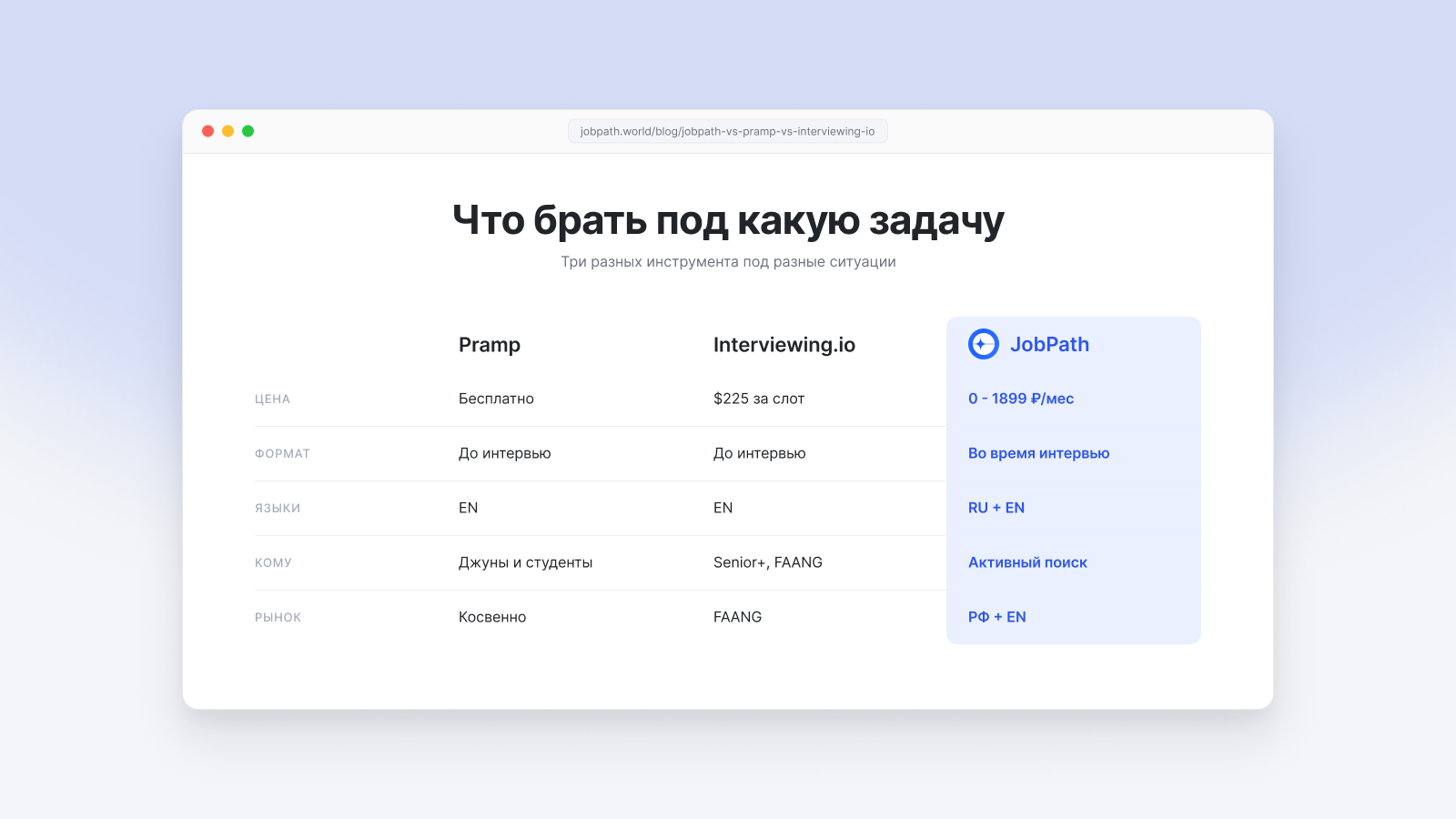
| Pramp | Interviewing.io | JobPath | |
|---|---|---|---|
| Format | Peer mock | Session with FAANG engineer | AI copilot during live interview |
| Cost | Free | $225+ per session | $0 – $31/mo |
| Language | EN | EN | EN + RU |
| When | Before interview | Before interview | During interview |
| Fits | Juniors, English practice | Senior+, FAANG | Anyone in active search |
| Ethically clean | yes | yes | debatable |
Where to start
If you're reading this with an actual interview coming up in a couple of weeks, the cheapest possible move is to grab JobPath free and install it. Setup is a minute, 15 minutes of AI-copilot per day covers the one call that actually matters. Pull the desktop client at jobpath.world, set your role and stack, run it on your next interview. If it pulls you out on one tough question, it paid for itself. If it doesn't, uninstall and forget.
Pramp and Interviewing.io are slower, more deliberate moves. Pramp for muscle memory talking through problems, Interviewing.io if international top-tier is the target.
One last thing. None of these tools replace prep. They're crutches with different purposes. Out of the three, one or two probably fit your specific situation, the rest are wasted time. Pick by scenario, not by what's trending.